

In early 2007, the ASPCA started running a television ad. Photographs of shelter dogs and cats scroll across the screen, one sadder than the last, while Sarah McLachlan sings “Angel.” By the end of 2008 it had raised roughly $30 million, the most successful fundraiser in the organization’s history. It also made a lot of people change the channel.
So does she. In a Reddit Q&A in 2014, someone told McLachlan the ads bummed them out, so they changed the channel. She answered: “I change the channel too. It’s the kitten with the droopy eye, or the 3-legged dog, bless them, it kills me.”
Here is the thing about those animals. Most of them were hurt by people. Somebody starved that dog, or dumped that cat, or never got the kitten’s eye looked at. That is moral suffering, and Part 1 already paid that bill. Free will, misused, lands on someone who did not choose it. So change the channel.
On the next channel is Planet Earth II. In the first episode, “Islands” (2016), the camera goes to Fernandina, in the Galápagos. Marine iguana hatchlings lie just under the sand to warm up, then break the surface and run for the rocks at the top of the beach, where the adults are. Galápagos racer snakes are waiting in those rocks. They pour out by the dozen, and the hatchlings run. Some make it. One is caught in a knot of snakes, wriggles free, and reaches the rocks. Many are not so lucky. The cameraman, Richard Wollocombe, wrote that it was the first footage ever of snakes hunting the hatchlings en masse.
Nobody chose that. Nobody sinned. No one is starving the snakes or dumping the iguanas.
That is the narrow claim of this part, and I am sure of it: animal suffering before humans cannot be punishment, because there was no one to punish, and no human sin can explain it. Part 2’s theories all assumed there were people in the world to grow, to choose, and to build badly. This part asks whether they stretch to cover the iguanas. I am much less sure of that.
The Last Thirty-Six Minutes
The iguanas are not a special case. They are the normal case, and it is very old.
The oldest known fossils of our species come from Jebel Irhoud, in Morocco, and date to about 315,000 years ago. Life on Earth is billions of years older than that. The asteroid that ended the age of dinosaurs hit Chicxulub, on what is now the Yucatán coast, about 66 million years ago. The physicist Luis Alvarez and his son Walter, a geologist, proposed the impact in 1980 from a thin layer of iridium in the rock, a metal rare on Earth and common in asteroids.
There is a site in North Dakota called Tanis where you can see the first hour. When the asteroid hit, the shaking sent a surge of water up a river valley about 1,900 miles away. It buried the fish where they were. More than half of the sturgeon and paddlefish found there have tiny glass beads in their gills: impact debris that rained down out of the sky and that they breathed in while they were still feeding.
That was one of five mass extinctions. It was not the worst. About 252 million years ago, at the end of the Permian, most species in the sea and much of life on land died out.
The scale is hard to hold in your head, so here is the usual trick. Squeeze Earth’s 4.54 billion years into one calendar year.
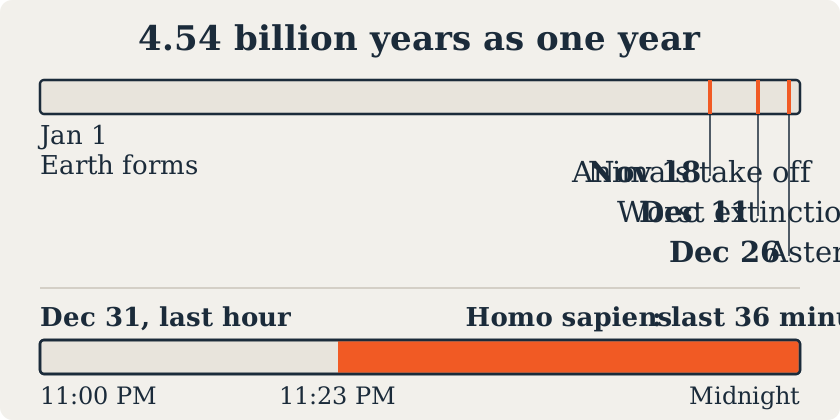
Animals take off in the Cambrian, around November 18. The worst extinction falls around December 11. The asteroid lands on December 26, the day after Christmas. We show up at about 11:23 PM on New Year’s Eve. Everything Part 2 said about growth, stable rules, and badly built cities happened in the last 36 minutes. For the rest of the year, the beach belonged to the snakes.
Too Much Misery
Charles Darwin felt this problem as sharply as anyone. In May 1860, six months after On the Origin of Species came out, he wrote to the American botanist Asa Gray, a devout Christian who had defended the book:
There seems to me too much misery in the world. I cannot persuade myself that a beneficent & omnipotent God would have designedly created the Ichneumonidæ with the express intention of their feeding within the living bodies of caterpillars, or that a cat should play with mice.
The Ichneumonidae are parasitic wasps. Many of them lay their eggs inside a living caterpillar, and the larvae eat it from the inside while it is still alive.
Darwin was not writing as an atheist. In the same letter he says he “had no intention to write atheistically,” and that he cannot look at the universe and conclude everything is “the result of brute force.” He was bewildered. “I feel most deeply that the whole subject is too profound for the human intellect,” he wrote. “A dog might as well speculate on the mind of Newton.”
Scripture does not let either of us off easy here. It does not treat predation as something that happens behind God’s back. “The young lions roar for their prey, seeking their food from God” (Psalm 104:21). And Jesus, on the cheapest birds in the market: “Are not two sparrows sold for a penny? Yet not one of them will fall to the ground apart from your Father” (Matthew 10:29). That is meant as comfort. It is also an admission that God is there when the sparrow falls.
No One to Punish
Here is the part I can say with some confidence. When we ask what the dinosaurs did to deserve it, the honest answer is that “deserve” does not apply. Deserving takes a moral agent: someone who knows better, can choose otherwise, and does not. A Tyrannosaurus is not a moral agent. Neither is the asteroid, or the snake.
Part 1 said moral suffering is consequence, not punishment. This is one step further out. It is not even the consequence of a choice. It is just what the world did.
I want to be honest about what that buys. It takes the problem off the scale of justice. It does not make the problem go away. It moves it to design. Nobody asks whether the iguana hatchling had it coming. People ask why a good God would build a world where hatchlings are born at the bottom of a beach full of snakes. That is Darwin’s question, and moving it does not answer it.
The Pains of Labor
This is where I have to be straight with you. This one stumps me. I am still thinking about it. I suspect it may be something we never fully understand. But I am going to try my best.
So here are four frames I take seriously, held loosely, with what each one fails to explain.
The first is from Paul. “For the creation waits with eager longing for the revealing of the children of God, for the creation was subjected to futility, not of its own will, but by the will of the one who subjected it, in hope that the creation itself will be set free from its enslavement to decay” (Romans 8:19–21). Then: “We know that the whole creation has been groaning together as it suffers together the pains of labor” (8:22). Most readers take “the one who subjected it” to be God.
Labor pains hurt, and they mean something is being born. In that reading, the groaning is not a breakdown. It is a delivery. This is Part 2’s growth theory, stretched to creation itself: a world not yet finished, being brought to completion.
The gap is the hatchling. In Part 2, the one who suffers is the one who grows. Here, what grows is creation as a whole. The iguana caught on the beach is not brought to completion by being eaten. If anything, Ivan Karamazov’s objection from Part 2 comes back harder. Ivan said a future harmony could not justify one tortured child. Paul’s harmony is real, and I believe in it, but it does not say why this hatchling.
Chaos to Order
The second frame is the philosopher Michael Murray’s, from Nature Red in Tooth and Claw (2008). Murray is careful about what he claims. He does not say he knows God’s reasons. He says there are reasons that, for all we know, could be true, and that would be good enough.
His best one goes like this. A universe that moves from chaos to order by its own regular laws is good in itself, and animal pain is an unavoidable byproduct of making one. That is Part 2’s stable world at the scale of a planet. Rain falls on the righteous and the unrighteous. Fire burns whoever touches it. A world that makes its own creatures over billions of years will make them by trial, cost, and death.
The best evidence for Murray, to my mind, comes from a surgeon. Paul Brand spent two decades treating leprosy in India. It was widely believed that leprosy made fingers and toes rot away. Brand showed that it does not. The disease kills the nerves that carry pain. His patients’ hands and feet wore away through small injuries no one felt: burns, blisters, and cuts that went untreated because they did not hurt. Pain was not their enemy. Losing it was. Brand and the writer Philip Yancey called their book about it The Gift of Pain (1997). In a living body, pain is a working part.
The best evidence against Murray comes from the philosopher Paul Draper. In 1989 he pointed out that useful pain is exactly what natural selection predicts, whether or not anyone designed it. A creature that feels a burn pulls away and lives to breed. Draper set theism against what he called the Hypothesis of Indifference: that the condition of creatures on Earth is not the result of anyone caring about them one way or the other. Brand’s patients fit indifference just as well as they fit design. Draper argues they fit it better.
That is why my head leans toward Murray without settling there. He gives a reason that could be true. He does not give one I can see is true.
An Older Rebellion
The third frame belongs to C.S. Lewis, from the chapter on animal pain in The Problem of Pain (1940). Lewis knew predation was older than us, so Adam’s fall could not explain it. He reached further back:
It seems to me, therefore, a reasonable supposition, that some mighty created power had already been at work for ill on the material universe, or the solar system, or, at least, the planet Earth, before ever man came on the scene.
Lewis means a fallen angel. If it happened, the snakes on Fernandina are not what God made. They are what something else did to what God made. Predation becomes damage, not design, and the free-will argument from Part 1 stretches all the way back. Isaiah’s picture fits it well: “The wolf shall live with the lamb; the leopard shall lie down with the kid,” and “They will not hurt or destroy on all my holy mountain” (Isaiah 11:6, 9). That would be a repair, not a change of plan.
Lewis called his last chapters “admittedly speculative,” and this is one of them. There is no text that says it happened. It also pulls against the verses above. If predation is corruption, it is strange to hear that the lions seek their food from God.
The Only Way
The fourth frame is the theologian Christopher Southgate’s, from The Groaning of Creation (2008). He takes his title from Romans 8 and his starting point from Darwin. His claim is that “an evolving creation was the only way in which God could give rise to the sort of beauty, diversity, sentience and sophistication of creatures that the biosphere now contains.” The cost was built into the only process that could produce the goods. Southgate admits this is an assumption he cannot prove.
He also refuses Lewis’s way out. Southgate counts an appeal to a fall before humans as a blind alley, and thinks the honest move is to say God chose this process knowing what it would cost. He does not stop there. He thinks the creatures who paid that cost are not forgotten, that God suffers with them, and that the hope in Romans 8 and Isaiah 11 is for them too. That last thought belongs to a later part, and I will leave it there.
The gap is the word “only.” Southgate cannot show that God had no other way, and neither can I. If there was another way, the question comes back.
We Had Hoped
Part 2 already said that some of this may only be visible from above the plane. I will not argue it again. I will just say where I am standing.
My head leans toward Murray, and toward Paul’s groaning creation. They fit what we can see: pain that does a job, a world that makes itself by rules, and a hope that points forward instead of backward. They also mean God built a world with the wasp in it. That is the conclusion Darwin could not accept.
My gut leans toward Lewis. I think that is just my human qualities going into this. In my mind, I would like there to be some corrupt action that explains it. That would put me at ease. But the point of theology is not to be put at ease. If it were, we could come up with much better answers than the ones we have. The disciples wanted a culprit too. “Rabbi, who sinned?” (John 9:2).
There is one more thing about Lewis. He wrote The Problem of Pain in 1940. His mother had died of cancer when he was nine, and he had been wounded in France in 1918, so he was not a stranger to pain. But in the preface he says “the only purpose of the book is to solve the intellectual problem raised by suffering.” The grief that tested him came twenty years later, when his wife, Joy Davidman, died, and he wrote A Grief Observed. I do not know that he ever changed his mind about the angel. I do know that I am holding my lean from about where he was standing when he wrote it. Life may show me why what I hope is true is not.
Jesus’s own disciples were in the same place. When he told them he would suffer and die, Peter took him aside and rebuked him, and Jesus told Peter he was “setting your mind not on divine things but on human things” (Mark 8:33). After the crucifixion, two of them walked to Emmaus and explained to a stranger what had happened: “But we had hoped that he was the one to redeem Israel” (Luke 24:21). They were not wrong to hope. They were wrong about the shape the answer would take, and the stranger was Jesus.
When God finally answers Job out of the whirlwind, much of what he talks about is animals. “Can you hunt the prey for the lion or satisfy the appetite of the young lions? … Who provides for the raven its prey?” (Job 38:39, 41). Of the eagle: “Its young ones suck up blood, and where the slain are, there it is” (39:30). That is the next part.
Sarah McLachlan can change the channel. On Fernandina, the next clutch is already under the sand, warming up for the run.
Further Reading
Scripture quotations are from the New Revised Standard Version Updated Edition (NRSVue).
- Where Were You — the series overview
- This Is My Luck — Part 1: inconvenience, moral suffering, and free will
- Time and Chance — Part 2: natural suffering, three theories, and Flatland
- Stephanie Strom, “Ad Featuring Singer Proves Bonanza for the A.S.P.C.A.”, New York Times, December 26, 2008 — roughly $30 million since early 2007
- Susanna Kim, “Singer Sarah McLachlan Changes the Channel on Own ASPCA TV Ad”, ABC News, May 7, 2014
- Planet Earth II, episode 1, “Islands” (BBC One, November 6, 2016); the iguana and snake sequence, BBC
- Richard Wollocombe, “Snakes versus dragons: how we filmed this sequence for Planet Earth II”, The Guardian, November 24, 2016
- Jean-Jacques Hublin et al., “New fossils from Jebel Irhoud, Morocco and the pan-African origin of Homo sapiens”, Nature 546 (2017): 289–292
- Luis W. Alvarez et al., “Extraterrestrial Cause for the Cretaceous-Tertiary Extinction”, Science 208 (1980): 1095–1108
- Robert A. DePalma et al., “A seismically induced onshore surge deposit at the KPg boundary, North Dakota”, PNAS 116 (2019): 8190–8199 — the Tanis fish, with impact spherules in their gills
- Charles Darwin to Asa Gray, May 22, 1860, Darwin Correspondence Project, DCP-LETT-2814
- Psalm 104:21 and Matthew 10:29 — the lions’ food from God; the sparrows
- Romans 8:18–23 — creation subjected to futility, in hope; the pains of labor
- Isaiah 11:6–9 — the wolf and the lamb
- John 9:1–3, Mark 8:31–33, and Luke 24:13–35 — “who sinned?”; Peter’s rebuke; the road to Emmaus
- Job 38:39–41 and Job 39:26–30 — the lion, the raven, and the eagle
- Michael J. Murray, Nature Red in Tooth and Claw: Theism and the Problem of Animal Suffering (Oxford University Press, 2008); see also the review in Notre Dame Philosophical Reviews
- Paul Brand and Philip Yancey, The Gift of Pain (Zondervan, 1997), first published as Pain: The Gift Nobody Wants (1993)
- Paul Draper, “Pain and Pleasure: An Evidential Problem for Theists”, Noûs 23 (1989): 331–350
- C.S. Lewis, The Problem of Pain (1940), preface and chapter 9, “Animal Pain”
- C.S. Lewis, A Grief Observed (1961)
- Christopher Southgate, The Groaning of Creation: God, Evolution, and the Problem of Evil (Westminster John Knox, 2008)
- Stanford Encyclopedia of Philosophy, “The Problem of Evil”


