
In part one I argued the country moved right, not left — and that the coalition selling that shift gutted the Goldwater brochure while a few factions cashed in. This essay is about the religious piece of that story: how evangelical institutions got mobilized, what the Southern Baptist Convention actually said about abortion in the early 1970s, and why “culture war” is better understood as strategy than as awakening.
I wrote about the flavor of Christianity I was first served in A Bigger Table. The Gospels put weight on neighbor, the poor, and the stranger. Abortion barely appears. The political church I grew up around treated niche fights as the whole faith. This post is one answer to how that happened — without pretending every pew was a plot, and without treating Barry Goldwater as the architect of Jerry Falwell.
Seedbed, Not Harvest
Goldwater’s Conscience of a Conservative (1960, with L. Brent Bozell Jr.) is limited government and states’ rights. It is not the Moral Majority. Goldwater later supported gays in the military — “you don’t need to be straight to fight and die for your country; you just need to shoot straight” — and said there was “no gay exemption” in the right to life, liberty, and the pursuit of happiness. In 1981 he warned the Senate he would fight religious factions that tried to dictate morals “in the name of conservatism.”
Paul Weyrich tried for years to pull evangelicals into electoral politics. Goldwater’s 1964 campaign lost. The Southern Strategy harvested the Deep South. The harvest of church politics — Moral Majority, SBC Conservative Resurgence — is late 1970s, not 1960. Do not date the takeover to the decade of the seedbed.
Roger Stone belongs in this story only as a dirty-tricks through-line: Goldwater volunteer as a kid, Nixon sabotage, NCPAC with Terry Dolan and Charles Black, Young Republicans, then Trump. He is not the theologian of the culture war. Weyrich, Falwell, and Richard Viguerie are the organizers.
What the SBC Actually Said
Do not say “the Baptist church was pro-choice.” Say the Southern Baptist Convention.
In 1971, SBC messengers passed a resolution that affirmed the sanctity of human life, including fetal life, and called on Southern Baptists to work for legislation allowing abortion in cases of rape, incest, severe fetal deformity, and “carefully ascertained evidence of the likelihood of damage to the emotional, mental, and physical health of the mother.” The text is still on sbc.net.
In 1974 — after Roe v. Wade — they reaffirmed that resolution as a “middle ground between the extreme of abortion on demand and the opposite extreme of all abortion as murder.”
W.A. Criswell, pastor of First Baptist Dallas and a former SBC president, praised Roe in 1973: he had “always felt that it was only after a child was born and had a life separate from its mother that it became an individual person,” and that what was best for the mother and the future should be allowed. He later reversed during the Conservative Resurgence that began in 1979.
By 1980, SBC abortion resolutions had narrowed the exception to the life of the mother. That is a denomination captured by political organizers — not a timeless theological discovery that somehow waited until the New Right needed a ballot line.
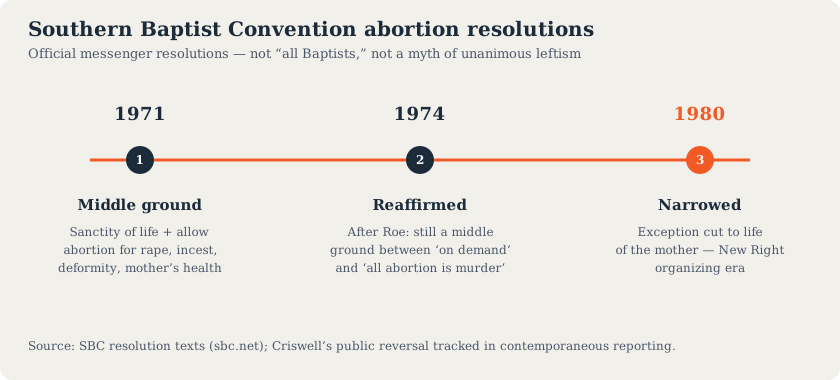
Christianity Today and others contest the pop claim that “evangelicals were pro-choice.” Fair. Do not overclaim a myth. The SBC resolutions and Criswell’s public reversal are enough without inventing a unanimous evangelical left.
Weyrich on the Record
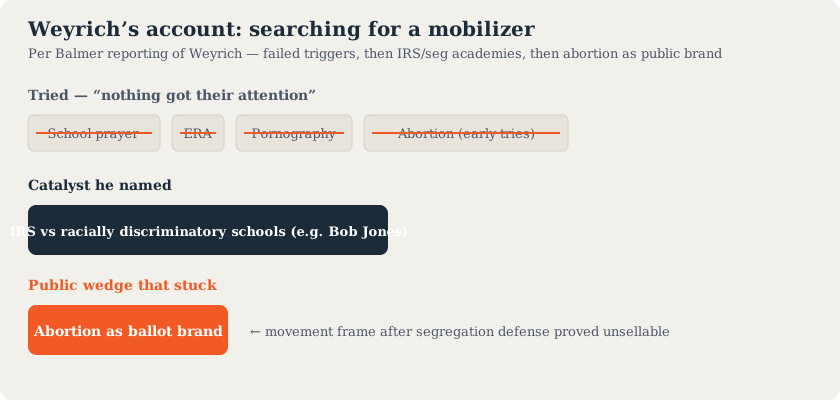
Historian Randall Balmer has argued for years that the Religious Right did not assemble as a political movement primarily over Roe. Paul Weyrich told him — emphatically — that he had tried abortion, school prayer, the Equal Rights Amendment, pornography. “Nothing got their attention” until the IRS moved against racially discriminatory schools, including Bob Jones University. Abortion became the public wedge after defending segregation proved unsellable.
Present that as Weyrich’s own account plus Balmer’s reporting — not as the only possible history of every evangelical conscience. Some Christians opposed abortion on theological grounds before 1979. The organizing catalyst Weyrich described was not Roe. The public brand became abortion. Those can both be true.
Jerry Falwell’s Moral Majority launched in 1979. Falwell’s first major anti-abortion sermon came years after Roe. The timeline matches a movement looking for a high-minded frame — not a spontaneous pew revolt the day the Court ruled.
Culture War as Strategy
Weyrich’s project was explicit: culture war as the fight that would keep a coalition mobilized. Family values as status and moral superiority. The Catholic anti-abortion movement already existed; Protestant and evangelical institutions had to be brought into that fight. The SBC’s own paper trail shows how far the official position moved in less than a decade.
That is what I meant in A Bigger Table when I asked how so many Christians treat Gospel emphasis on the poor and the stranger as optional while niche fights that barely appear in the text become litmus tests. You do not need every Christian to have been conned. You need organizers who found that wedge issues turned out churches, and churches that let politics rewrite the emphasis.
Goldwater saw the danger early and said so. The party that still name-checks him chose Falwell’s coalition anyway. Part one is how far modern leaders strayed from Goldwater’s limits. This essay is how the religious infrastructure for that stray was built.
What This Does Not Prove
It does not prove every Southern Baptist in 1971 was a feminist. The 1971 resolution was a middle ground with a sanctity-of-life preamble — not “abortion on demand.”
It does not prove Democrats never used religion. They did.
It does not prove sincere pro-life conviction is fake. Many people hold it sincerely. The question is whether the political Religious Right began as a pure response to Roe, or whether organizers found abortion after other triggers failed and then remade denominational politics to match. Weyrich’s account and the SBC timeline support the second story for the movement. Individual consciences are their own.
Sources
SBC resolutions and Criswell:
- Resolution On Abortion (1971) (Southern Baptist Convention)
- Was the Southern Baptist Convention Ever ‘Pro-Choice’? (Good Faith Media)
- The Religious Right and the Abortion Myth (Randall Balmer, Politico Magazine, May 2022)
- Evangelicals and abortion: chicken or egg? (Baptist News Global)
Weyrich / Bob Jones / Moral Majority:
- Randall Balmer, Bad Faith: Race and the Rise of the Religious Right
- There’s a straight line from US racial segregation to the anti-abortion movement (Balmer, The Guardian)
- Paul Weyrich / Moral Majority founding (1979); ALEC and Heritage co-founding as movement infrastructure
Goldwater on religion and gay rights:
- Goldwater on religion in politics (1981 Senate remarks)
- Goldwater backs lifting gay ban (Los Angeles Times, 1993)
Related on this site:
- A Bigger Table
- The Country Shifted Right (series overview)