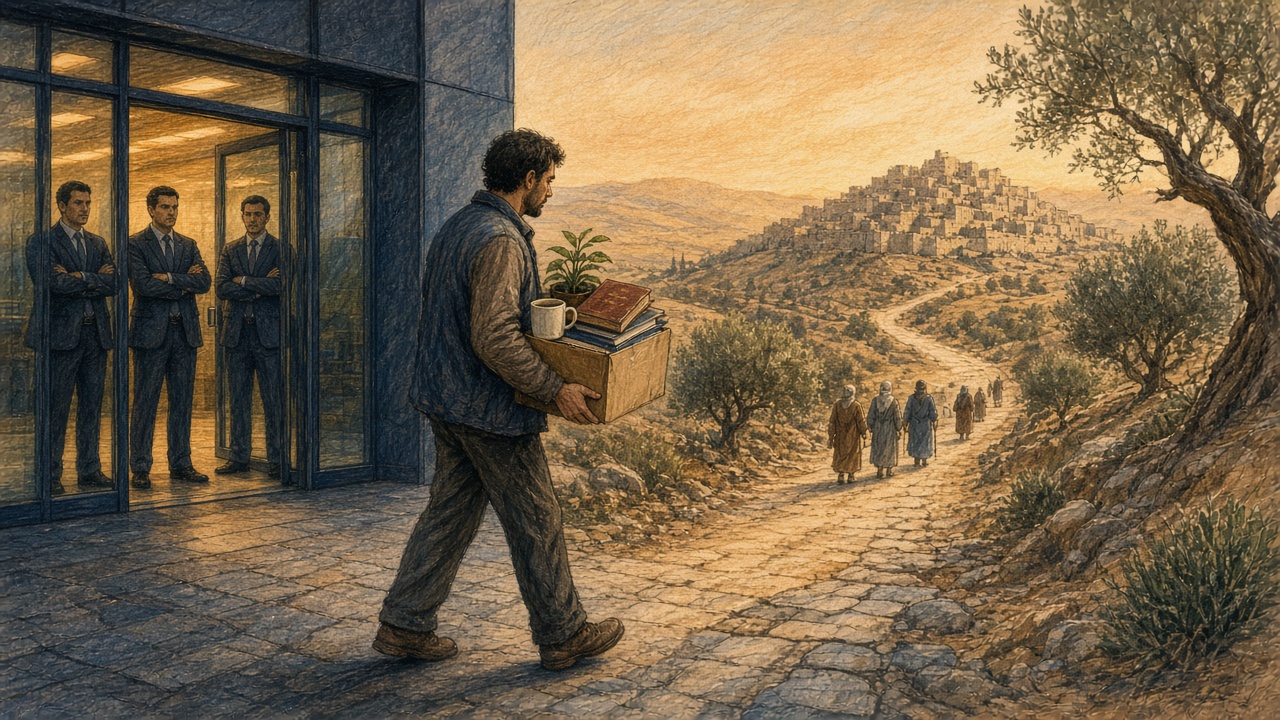
I read the Gospel of Matthew while my job was coming apart. I had grown up around Christianity, and I assumed I already knew what was in there. I did not. Until I read Matthew straight through, I did not realize how much Jesus actually struggled.
Eleven Years a Cast Member is the record of how my time at Disney ended. This essay is the other half of that year — what I was reading while it happened, and what it did to me. The claim is narrow. If you have been ostracized, bullied, or pushed out by people with a lot of authority to lose, you are in good company. That is largely the story of Jesus. And Matthew does not leave it as an inference; Jesus says it outright, in the first long sermon the book records. I will get to that line at the end.
Not Blessed Are the Powerful
The first thing that stopped me was the Beatitudes — the list of blessings that opens the Sermon on the Mount, the first long block of Jesus’s teaching in Matthew (5:3–10):
Blessed are the poor in spirit, for theirs is the kingdom of heaven.
Blessed are those who mourn, for they will be comforted.
Blessed are the meek, for they will inherit the earth.
The list goes on: those who hunger and thirst for righteousness, the merciful, the pure in heart, the peacemakers, the persecuted.
I found it beautifully direct. Look at who is on that list, and then look at who is not. Not blessed are the powerful. Not blessed are the rich. Not blessed are the wealthy. Matthew’s version says “poor in spirit,” and I am not going to pretend it says something else. Luke’s telling of the same teaching removes the doubt: “Blessed are you who are poor,” and four verses later, “But woe to you who are rich, for you have received your consolation” (Luke 6:20, 24).
It feels like my whole perspective on life changed. I was looking at the world wrong this whole time.
There is one more blessing at the end of that list. I am going to hold it.
The Messiah They Had Already Drawn
The Messiah was the anointed king from David’s line that Israel was waiting for, and many expected him to restore the kingdom and break foreign rule. People had come up with their own vision of what he would be — what he would look like, how he would act, and what his arrival would mean for them. Jesus did not match all of that. So they were inclined not to believe.
Matthew keeps showing it, and not only among his enemies.
His hometown heard him teach and asked, “Is not this the carpenter’s son?” And they took offense at him. Jesus answered, “Prophets are not without honor except in their own hometown and in their own house” (13:54–57). His mother and brothers stood outside while he taught, wanting to speak to him, and he pointed to his disciples instead (12:46–50). Mark’s version of that scene is blunter: his family went out to restrain him, because people were saying, “He has gone out of his mind” (Mark 3:21).
John the Baptist — the man who baptized him — sent word from prison: “Are you the one who is to come, or are we to wait for another?” (11:2–3).
Peter, closest of the twelve, heard Jesus say he would suffer and be killed, took him aside, and rebuked him: “God forbid it, Lord! This must never happen to you.” Jesus told him he was “setting your mind not on divine things but on human things” (16:21–23).
And at the end, the mockery under the cross: “He saved others; he cannot save himself. He is the King of Israel; let him come down from the cross now, and we will believe in him” (27:42).
We will believe in him. On condition that he matches the picture. Sit with that.
Authority to Lose
The people who worked hardest to discredit him were the religious authorities of his day. The Pharisees were a movement devoted to strict observance of the law. The chief priests ran the Temple in Jerusalem. The council was the high court that sat under the high priest. These are specific officeholders, not a people — Jesus and every one of his disciples were Jews.
The Pharisees “conspired against him, how to destroy him” (12:14). When he healed, they said his power came from the devil: “It is only by Beelzebul, the ruler of the demons, that this man casts out the demons” (12:24). When he taught in the Temple, the chief priests and elders came with the question of people whose standing is the thing at stake: “By what authority are you doing these things, and who gave you this authority?” (21:23). At his trial, the council was “looking for false testimony against Jesus so that they might put him to death, but they found none” (26:59–60). Even Pilate “realized that it was out of jealousy that they had handed him over” (27:18).
Rome had its own reasons not to want any of it to be true. Rome had spent generations building absolute power over its provinces, and it held that power partly by making examples of anyone who looked like the start of an uprising. A man drawing crowds, healing people, and being called a king was a threat to manage.
Matthew opens on that fear. Herod the Great ruled Judea as a king by Rome’s appointment. When foreign visitors arrived asking, “Where is the child who has been born king of the Jews?”, Herod “was frightened, and all Jerusalem with him” (2:2–3). Then he killed every child in and around Bethlehem two years old or under (2:16). A king who already has the title hears of a baby with a claim to it.
The trial turns on it too. Pilate, the Roman governor, saw “that a riot was beginning,” washed his hands before the crowd, and said, “I am innocent of this man’s blood; see to it yourselves” (27:24). Crucifixion was the punishment Rome reserved for slaves and rebels — slow, public, and meant to be seen. Over Jesus’s head they put the charge against him, which read, “This is Jesus, the King of the Jews” (27:37). A claim to be king was sedition. They responded the way power responds to a threat: they optimized for its elimination.
He Found It Hard
I had pictured Jesus as serene. Matthew’s Jesus is not serene.
On the night of his arrest, in the garden of Gethsemane, he told his friends, “My soul is deeply grieved, even to death; remain here, and stay awake with me.” Then he threw himself on the ground and prayed, “My Father, if it is possible, let this cup pass from me, yet not what I want but what you want” (26:38–39). He came back and found them sleeping. “So, could you not stay awake with me one hour?” (26:40). When the soldiers came, “all the disciples deserted him and fled” (26:56). Before morning, Peter had denied knowing him.
On the cross, he cried with a loud voice, “My God, my God, why have you forsaken me?” (27:46).
He was not openly embraced. He found it difficult.
The Same Behavior
That same behavior happens in humans today. I watched it from the inside.
I spent more than eleven years on the technology side of Disney. The series covers it in eight parts, and I am not going to recap them. By the time I read Matthew, the pattern was familiar. Power was hoarded upstairs and responsibility distributed down (Part 3). A proven lead was laid off over a zip code, and a mandate drove out the best people faster than an honest layoff would have (Part 6). Legitimate problems, raised the way I was told to raise them, came back as “that is a job” (Part 7). The series says it at the start, and I will say it again: as far as I know, nobody broke the law. It never takes a crime. People with authority to lose, faced with someone who does not fit their picture of how things should work, protect the picture.
A job is not a cross. I am not comparing what happened to me with what happened to him, and I am not going to rank them. The scale is not the point. The pattern is: people with standing to lose, something that threatens the standing, and a response built to remove the threat.
Good Company
When Jesus sent out the twelve, he warned them what to expect:
A disciple is not above the teacher nor a slave above the master; it is enough for the disciple to be like the teacher and the slave like the master. If they have called the master of the house Beelzebul, how much more will they malign those of his household! (10:24–25)
So the next time you are ostracized, know that it is easy to be angry and upset. I know because I was. For a long time I was so overcome with anger that it stopped me from moving forward and fulfilling my own potential. Now I see that potential as something God blessed me with. It is on me to figure out how to move on and use it for his purpose instead of trivial human concerns.
Matthew has a parable for exactly that. A man going on a journey entrusts his property to his servants in talents — a talent was a large sum of money, and the English word for a gift comes from this story. Two servants trade with theirs and double it. The third digs a hole and buries his. “I was afraid,” he says, “and I went and hid your talent in the ground” (25:14–30). His emotion was fear. Mine was anger. The details are not the same. But an emotion brought both of us to the same place, with the gift still in the ground. The difference is that I was finally awoken to what is truly important.
Two of the twelve failed Jesus on the same night. Judas went to the chief priests and sold him for thirty pieces of silver. Peter, in the high priest’s courtyard, denied knowing him three times, and when the cock crowed “he went out and wept bitterly” (26:75). When Judas saw that Jesus was condemned, he repented — that is Matthew’s word — brought the silver back, and hanged himself (27:3–5). Both were moved by human urges. Both came to regret it. When the book closes, “the eleven disciples went to Galilee, to the mountain to which Jesus had directed them” (28:16), and Peter is among them. Eleven. An emotion can carry anyone to the same bad place. What matters is whether you wake up there.
The people who push you out are imperfect humans behaving the way imperfect humans do. So were Peter and Judas. So am I.
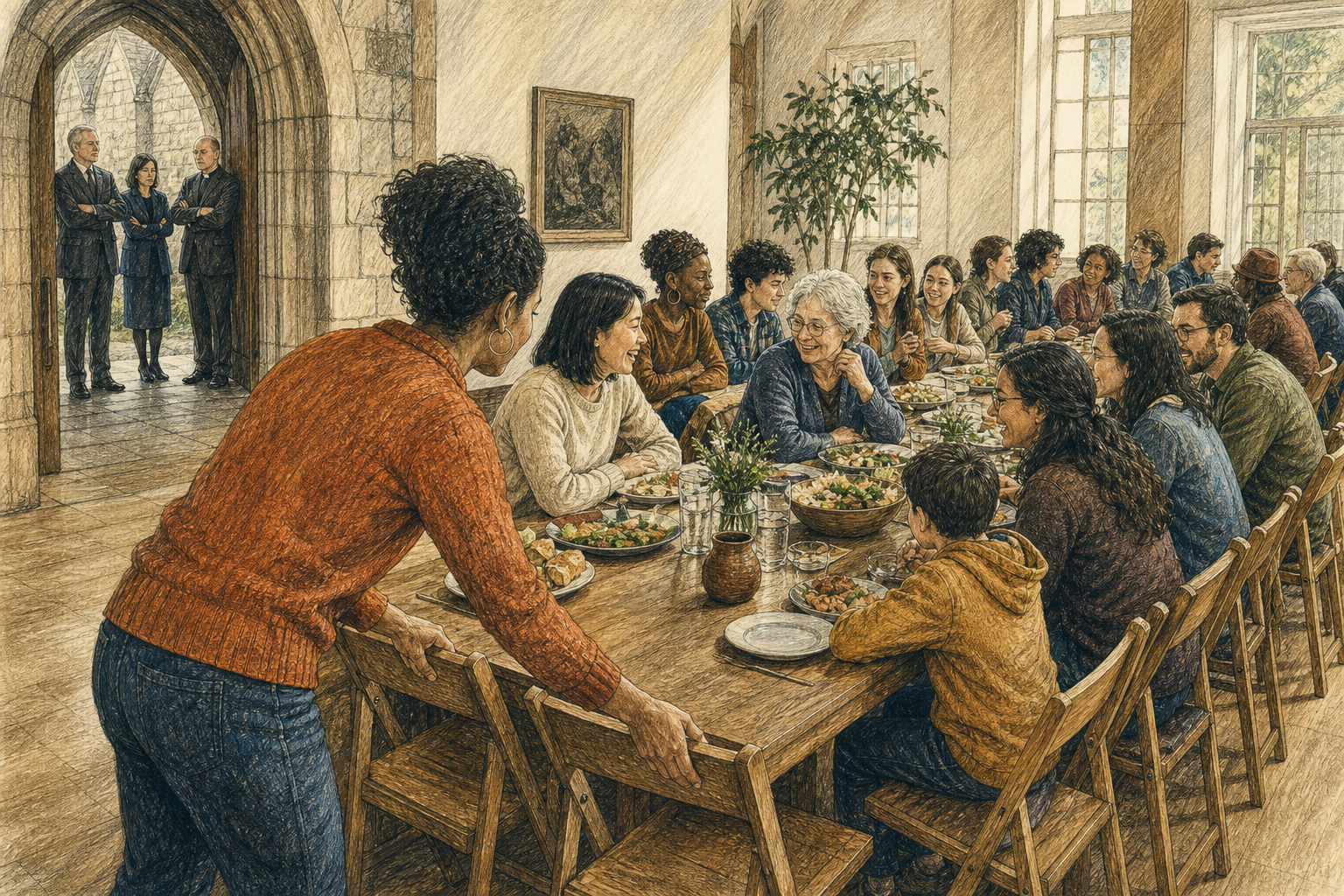
What I am doing now is less dramatic than any of this. I am moving on. I am focusing on being a better person myself. I am reading the Bible. I am praying. I am looking at my community through the lens of how we can improve it: how we can better make sure people are not going hungry, not going without health care, not going without shelter. That is the measure Jesus gives in Matthew 25, the one I wrote about in A Bigger Table.
Keep doing what you are doing. Do not let the ignorant stand in the way of success and goodness.
The last blessing on the list in chapter 5, the one I held back, is addressed to you:
Blessed are you when people revile you and persecute you and utter all kinds of evil against you falsely on my account. Rejoice and be glad, for your reward is great in heaven, for in the same way they persecuted the prophets who were before you. (5:11–12)
Over his head, the people with authority to lose put the charge in writing: This is Jesus, the King of the Jews. They meant it as mockery. It was true.
Further Reading
Scripture quotations are from the New Revised Standard Version Updated Edition (NRSVue).
- Matthew 5:3–12 — the Beatitudes, ending with the blessing on the persecuted
- Luke 6:20–26 — Luke’s blessings and woes: “Blessed are you who are poor,” “woe to you who are rich”
- Matthew 2:1–16 — the magi, Herod’s fear, and the massacre at Bethlehem
- Matthew 10:24–25 — “If they have called the master of the house Beelzebul”
- Matthew 11:2–3, 12:46–50, 13:54–57, 16:21–23 — John’s question, his family, his hometown, and Peter’s rebuke; with Mark 3:21
- Matthew 12:14–24, 21:23, 26:59–60 — the plot, the Beelzebul charge, the authority question, and the false witnesses
- Matthew 25:14–30 — the parable of the talents
- Matthew 26:36–75 — Gethsemane, the arrest, and Peter’s denial
- Matthew 27:1–46 — Judas, Pilate, the charge over the cross, and the cry of abandonment
- Matthew 28:16–20 — the eleven on the mountain
- Martin Hengel, Crucifixion in the Ancient World and the Folly of the Message of the Cross (Fortress Press, 1977) — what crucifixion was for, and who received it
- A Bigger Table — where this journey started
- Eleven Years a Cast Member — the series overview