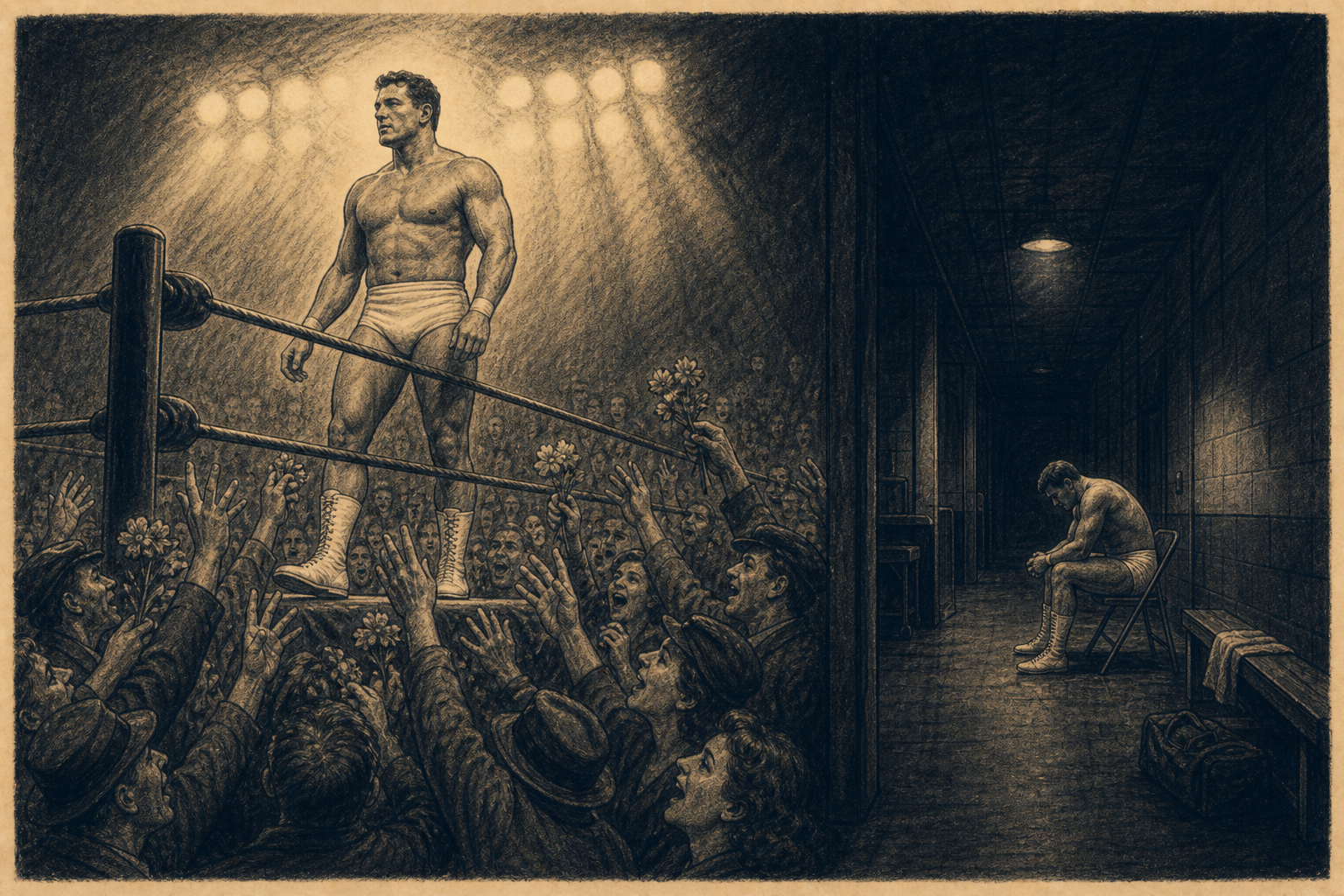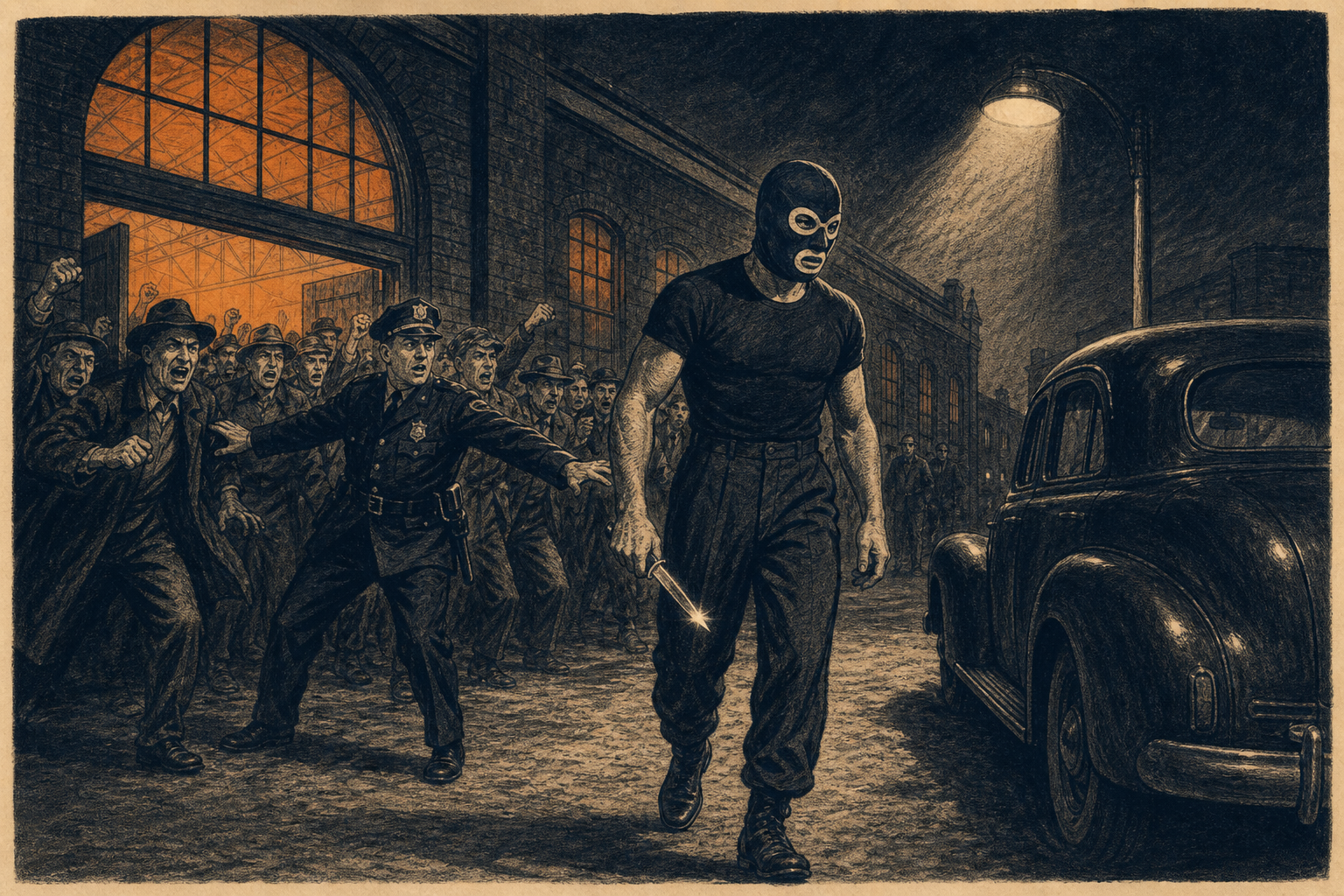
Ask the Nashville police who priced the Hippodrome if this was fake. The Green Shadow — Pat Malone, a 200-pound mystery heel in a cheap hood — made the room so hot that the cops who worked security demanded a raise from the promoters. I wrote that bill in The Cost of Heat. Malone kept a Barlow in the boot. Forty years later Jim Cornette wore a borrowed vest under his clothes in Little Rock because the building might turn. In The Other Cage the inverted bill is John Cena throwing cash on a dinner table because a plane was waiting. The job followed them out of the building. One man needed steel. One needed Kevlar. One gave up the ordinary Tuesday.
The finishes were predetermined. That is not the argument. Fake is the wrong word for the bill. The raise, the knife, the vest, the plane were not a work. Neither was the harness. Neither was the neck.
The Word
What the couch means by fake: someone already knew who was going over. The Lost Art of Professional Wrestling already covered the wink, and the night the office said entertainment for a tax reason. This is the street version of the same word. It does not land on the finish. It lands on the people who paid, in body and in life, to make the story hold.
Sixteen Minutes
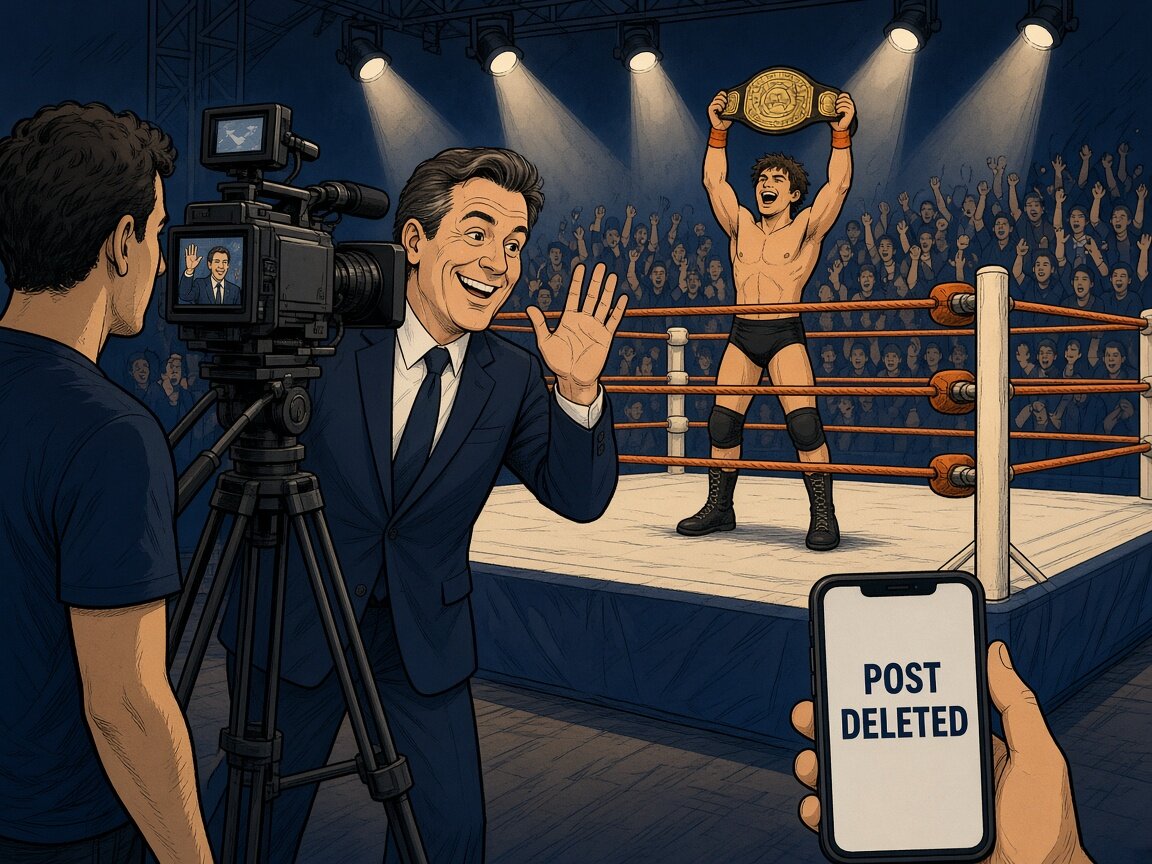
Vince Russo was the WWF’s head writer in 1999. He booked crash TV — five to eight minutes, boom, what’s next — and he has spent the years since saying the product is a television show.
On January 27, 2010, he posted a blog. TNA Impact had drawn a 1.3 for three weeks. A man with a stopwatch had counted sixteen minutes of wrestling. Russo was proud of both. Then this:
How can something so trivial mean so much to somebody that they would actually sit there and count how many minutes of fake wrestling were on a fake wrestling show in the course of two hours?
Sit with that.
The next day he quoted himself — “Fake wrestling on a fake wrestling show” — and apologized. Taz had told him how the locker room heard it. In the apology he almost writes the rest of this page. Nothing fake about the injuries. Nothing fake about the hours away from family. Nothing fake about the twilight of a career when wrestling is all you know. Then he goes back to the job: treat it as a television show, because that is what it is.
I am not going to treat the apology as growth. He kept the frame. The fire is not that a writer called a finish predetermined. The fire is that he chose those words after he already knew what the bill cost.
The Harness
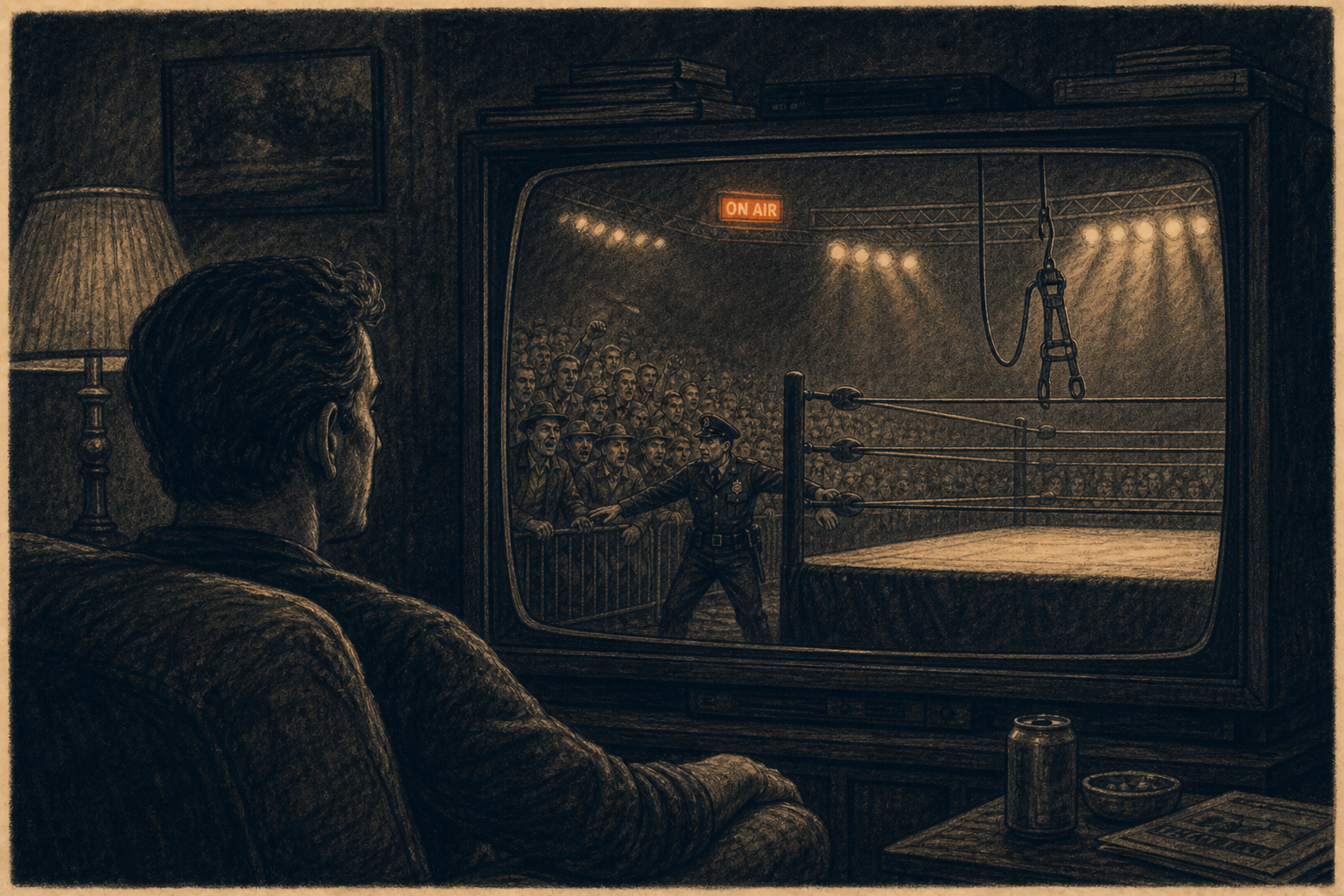
May 23, 1999. Kemper Arena. Over the Edge. Owen Hart was coming down as the Blue Blazer, a comedy superhero, for a pay-per-view entrance — not for the match. The bit was to stop a few feet above the mat, get tangled, and fall on purpose. They put him in a quick-release harness so the comedy would time out. He fell seventy-eight feet. The show continued.
Russo’s own telling: the Friday before, a rigging company that had dropped Sting called. The card was already written. He looked at it, saw Owen, and suggested rappelling the Blazer. The day of the show, Owen came up to him. The harness took too long to get off. If The Godfather was waiting in the ring, he could pummel him. Could the entrance come first. Russo said he would make the change.
I am not going to mash the tellings into one. Jim Cornette blames Russo for an unnecessary stunt in a costume Owen did not need. Russo calls the idea innocent. The useful fact is the third one. He was the writer. He was in the building. Owen talked to him about the harness. Eleven years later the same man asked how anyone could time fake wrestling on a fake wrestling show.
Jim Ross, on the air, told the people watching it was not a wrestling angle. As real as can be.
The Neck
October 5, 1999. Nassau Coliseum. A SmackDown taping. Darren Drozdov — Droz, six-three and about 280 — took D’Lo Brown’s running powerbomb. The shirt was loose. The grip was not there. Two vertebrae. He left the building a quadriplegic. He later got some of the upper body back. He kept writing for the company. He died in 2023. This room is 1999.
Russo was not in that building. He had called Vince McMahon that week and walked to WCW. A South Coast Today piece dated October 8 pairs the jump and the broken neck as the same week’s news. It was still the television he had been writing. Same week he left, a man on that show could not walk.
The move was a work. The spinal cord was not. I am not ranking Owen against Droz. Spectacle and canvas.
The comedy was supposed to stop a few feet above the mat. The harness had the rest of the building in it. The stopwatch never got to those unused feet.
A mark on the couch can say fake. He is guessing at a finish. He does not know the bill. Russo was not on the couch. He wrote the card. Owen asked him about the harness. He walked the week the neck broke. Then he reached for the word as if he were still in the armchair, and he did it in a sentence — a blog, a stopwatch, a shrug. That is the offensive part. Not the outsider who never saw what the word named. The man inside the business who used it anyway.
The television-show line writes off the people who laid the foundation he ate from. Malone is one of them. Russo has never had to know his name. Without rooms that hot, there is no business long enough to need a head writer. Without the NWA there is no national audience for Vince to raid and sign. Russo wrote the show that sat on that raid. He called it a television show.
Do not be surprised that a large part of the audience wants nothing to do with him. Those unused feet were already on his card.
Further Reading
- The Cost of Heat
- The Other Cage
- The Lost Art of Professional Wrestling
- J.R. Lind — “The Greatest Wrestling in the History of the World” (Nashville Scene, 2019)
- 411mania — Russo blog, January 27, 2010
- Wrestling Inc — Russo apology, January 28, 2010
- Pro Wrestling Stories — Russo on Owen, the Friday call, and the harness conversation
- CBC — Harts, WWF settlement approved
- South Coast Today — Russo leaves WWF; Droz injured, October 8, 1999
- Jim Ross — Droz, fifteen years on (Fox Sports, 2014)