
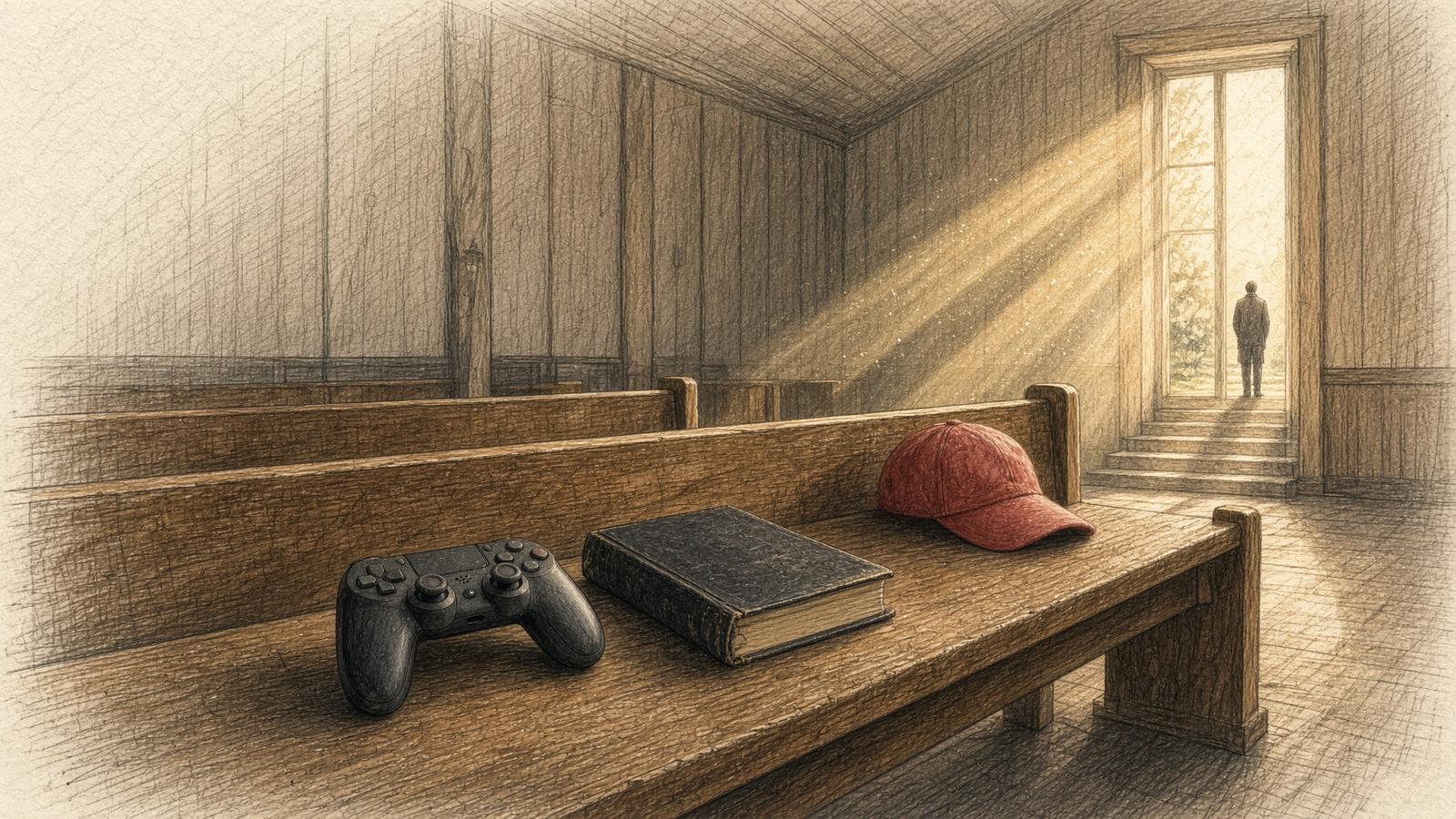
In one of the videos that went around before Grand Theft Auto VI came out, a young man invites his friend to church. The friend wants to keep playing. “Come on, dude,” he says. “It’s just a game.” The first man asks the same question twice: “GTA VI, or Jesus Christ? Which one?” Then he heads for the door. “I’ll be going to church. You could come with me if you want. I’ll wait for you.” It closes with Matthew 6:24: “No one can serve two masters.”
Rockstar released the game on November 19 at $79.99 for the standard edition. In the weeks before, short videos like that one filled Instagram, TikTok, and YouTube. A pastor’s warning to men. Two Baptist pastors answering “Should Christians play GTA VI?” with no. A church planter in Rochester, New York, started a pledge: “Christians, Honor Christ: Pledge to Abstain from GTA 6.” One creator, in a clip that was reposted widely, said the game “is going to be full-blown idolatry, if it isn’t already.”
Then the Babylon Bee, the Christian satire site, released a game of its own.
The fair version
I want to start with the strongest form of the argument, because some of it is right.
The same creator said something I agree with. “Instead of asking the question, does this convict me or am I allowed to do this? We need to be asking the question, God, does this please you?” That is a good question. Paul spends a whole chapter of Romans on believers who disagree about what to eat and which days to keep, and his answer is not that it does not matter. It is: “Let every man be fully persuaded in his own mind.” A Christian who looks at a game built around drugs, strip clubs, and killing, and decides not to spend eighty dollars and a hundred hours on it, is making a legitimate call. I am not going to tell anyone to buy it.
I am not buying it either, though my reason has nothing to do with the strip clubs. More on that below.
So the trouble is not that these Christians asked whether a game pleases God. It is what the question was not asked about. A movement that will organize a pledge against a video game has stopped asking that question about the man it elected, about its poor neighbors, and about the people who made the game. Jesus had a name for this.
The gnat
In Matthew 23, Jesus addresses the scribes and Pharisees:
Woe unto you, scribes and Pharisees, hypocrites! for ye pay tithe of mint and anise and cummin, and have omitted the weightier matters of the law, judgment, mercy, and faith: these ought ye to have done, and not to leave the other undone. Ye blind guides, which strain at a gnat, and swallow a camel.
Read the middle of that carefully. Jesus does not tell them to stop tithing their herbs. “These ought ye to have done.” The charge is not that they were too careful about small things. It is that the care stopped there. They strained their drinking water for insects and swallowed the camel whole.
Judgment, mercy, and faith. Take them one at a time.
Faith: the man they elected
In April, Donald Trump posted an AI-generated image of himself as a Jesus-like figure. After the backlash, he deleted it and said it showed him “as a doctor, making people better.” Franklin Graham, the son of Billy Graham and the head of Samaritan’s Purse, defended him. He dismissed the criticism, said he did not believe Trump knowingly depicted himself as Jesus, and called him the most “pro-Christian” president of his lifetime. It was Marjorie Taylor Greene, of all people, who said Graham should be pointing Trump toward Christianity instead.
In February, Trump’s Truth Social account posted a video that showed Barack and Michelle Obama as apes. The White House called the reaction “fake rage.” The post came down. There was no apology. Christianity Today published an editorial that day saying evangelicals “should no longer contort themselves to support a morally bankrupt leader.” Other evangelical leaders, as one headline put it, were divided.
I have written about the longer record in The Gift That Blinds, and I will not repeat it here. Apply the creator’s own question to these two posts. God, does this please you? Then notice that nobody made a pledge.
This is not a new reflex. It is a reversed one. In 2011, the Public Religion Research Institute asked whether an elected official who commits an immoral act in their personal life can still behave ethically in public office. Thirty percent of white evangelicals said yes. By October 2016, it was 72 percent. The standard did not get stricter for video games. It got looser for one man, and the polling shows exactly when.
Mercy: the neighbors
Homelessness in the United States set a record in January 2024. It has fallen in the two counts since, to 698,425 people this January, and HUD’s own secretary says it remains near historic highs. Chronic homelessness, meaning people who have been without housing for a year or more while living with a disability, did set a record in 2025: 155,750 people, nearly double the 2016 figure. Meanwhile, the share of the nation’s wealth held by the top 1 percent reached 32.5 percent in the second quarter of this year, the highest in the Federal Reserve’s data, which go back to 1989.
The enhanced premium subsidies for Affordable Care Act plans expired at the end of 2025. Marketplace enrollment fell from 21.8 million people to 19.2 million, the largest drop since the marketplaces opened. Counting Medicaid and CHIP, enrollment fell by about eight million from February 2025 to February 2026. Research on what happens next is consistent: people who lose coverage get less care and fill fewer prescriptions, and one large study of Medicaid expansion found that gaining coverage measurably lowered deaths among low-income adults. The reverse holds too. Today there are people rationing medicine they can no longer afford.
About 4.7 million people lost SNAP benefits after the 2025 reconciliation law’s changes took effect. By June, participation was the lowest it had been since August 2009, though food prices had not come down. The administration also cut the USDA survey that measures food insecurity, so it will be harder to count how many people are skipping meals.
The president’s response has been to deny the premise. He has called the affordability crisis a “hoax,” and in September called it “fake.” In February, he told Congress the country was in a “golden age.”
In the midterms this month, white evangelicals voted Republican by about 82 percent, according to the NBC exit poll. That number has barely moved since 2016. To be fair, the turnout in heavily evangelical counties fell, and the Republican margin there narrowed. Some evangelicals stayed home. That is not the same thing as speaking up.
Matthew 25 is the passage where Jesus describes the final judgment, and the criterion he gives is not what anyone declined to do:
For I was an hungred, and ye gave me meat: I was thirsty, and ye gave me drink: I was a stranger, and ye took me in: Naked, and ye clothed me: I was sick, and ye visited me.
No one in that scene is asked what they refused to play. I wrote in Ye of Little Faith that our excess belongs, in part, to the neighbor who needs food, a roof, or warmth. Count the hours that went into the scripts, the filming, the pledge page, and an entire free browser game. Then count the neighbors.
Judgment: the workers
There is a better reason not to buy Grand Theft Auto VI, and the pledges skipped it.
In October 2025, Rockstar fired more than 30 workers in the United Kingdom and Canada while they were working on the game. All of them were connected to a private chat run by organizers from the Independent Workers’ Union of Great Britain. Twenty-three brought a claim before an employment tribunal in Glasgow. Their lawyer called the firings “shock and awe,” timed for the moment the union’s membership at the studio was approaching 10 percent. They also allege that Rockstar monitored the union’s chat, blacklisted organizers, and targeted leaders. More than 200 Rockstar employees signed a letter to management in support of the fired workers.
Rockstar’s account is different. It says the workers were fired for leaking confidential information about upcoming and unannounced games in that chat, and not for joining a union. In June, the tribunal allowed every one of the workers’ allegations to go to a full hearing. The hearing closed last week. There is no verdict yet. Meanwhile, Rockstar’s UK staff are voting on union recognition, in a ballot that runs through November 26.
I would call what Rockstar is accused of rent seeking. The term means spending resources to capture a larger share of existing value rather than to create more of it. A union lets workers bargain together instead of one at a time with a company of more than 4,700 people. Every dollar spent preventing that is spent to keep the terms one-sided, not to make a better game. Economists often point to unions as the textbook rent seekers, and the reply is simple: workers bargaining together is the market working. Paying to stop them is the part that produces nothing. In the UK, firing someone for union activity is also illegal.
Scripture is not quiet about this. Jeremiah: “Woe unto him that buildeth his house by unrighteousness… that useth his neighbour’s service without wages.” And James, more bluntly than anything in the Bible says about entertainment:
Behold, the hire of the labourers who have reaped down your fields, which is of you kept back by fraud, crieth: and the cries of them which have reaped are entered into the ears of the Lord of sabaoth.
If a Christian wanted a biblical case against buying this game, this was it. The pledges were about the strip clubs in the game, not the workers who built it.
My own reason is smaller. I bought Grand Theft Auto V on Steam in 2015, and I cannot play it, because Rockstar’s launcher wants a college email address that no longer exists. I wrote about that in An Address That No Longer Exists. Rockstar’s support team has until November 24 to respond. I am not buying the sequel until it does.
One more thing is on the record, and I want to be careful with it. Rockstar’s privacy policy, which is the policy for all of Take-Two, says the company collects “gameplay information,” including scores, performance, device IDs, “and other information and statistics regarding your use of the Services.” It builds what it calls “Profile Inferences” to “create a personalized profile.” And it says that “in the last 12 months, Take-Two has sold and/or shared unique identifiers, IP address, as well as Internet/Electronic Activity and Profile Inferences with third-party advertising providers.” The policy does not say exactly what the game records or what those profiles contain, and I do not know. A claim that went viral last week, that the game scores players’ psychology for insurers and employers, has no evidence behind it so far. But the groundwork is in writing: the company says it collects how you play, builds a profile from it, and sells or shares that profile with advertisers.
The Christian alternative
The Babylon Bee released Grand Faith Auto at noon on November 18, a day before Rockstar’s launch. It is free and runs in a browser. The Bee’s post announcing it said the original “will cost your eternal soul plus $80.” Seth Dillon, the Bee’s CEO, wrote that it was not as good or as fun as the original, of course, because it is a Christian alternative, “but it exists and that’s all God expects or requires of us.”
He is joking about Christian media, and the joke is fair. I would not hold a satire site to the standards of a sermon. But satire shows what its makers find funny and whom they treat as the enemy, and Grand Faith Auto is specific about both. April Ajoy, who played it on her channel so the rest of us would not have to, walked through it. You “preach” to a driver and take his car. You defend a deli from a terrorist by throwing Bibles at him; once converted, he donates his guns to the church. You sneak into a cartel’s warehouse and swap the drugs for Jesus figurines.
And at one point the game directs you to a pride flag and tells you to pray about it. When you do, it turns into an American flag, and the screen says: “MIRACLE! FREEDOM +1776.”
Two things happen in that one moment.
The first is ridicule. Gay people exist in this game only as something to be prayed out of sight. Christians disagree, sincerely, about sexual ethics, and this essay does not need to settle that. Nothing in the New Testament tells any of us to mock anyone. The instructions run the other way: “Let your speech be alway with grace, seasoned with salt.” Give an answer “with meekness and fear.” Love your neighbor as yourself. A joke built on contempt is not a Christian alternative to anything.
The second is what replaces the flag. The answer to prayer in this game is not a changed heart or a reconciled neighbor. It is a national flag and a score labeled FREEDOM. The miracle is a country. The creators who called Grand Theft Auto VI idolatry did not say anything about the parody that rewards prayer with a flag. Paul wrote to the Philippians that “our conversation is in heaven,” using a word for citizenship. Leviticus says that “the stranger that dwelleth with you shall be unto you as one born among you, and thou shalt love him as thyself.” Jesus counted among the saved those who took the stranger in. In Grand Faith Auto, the strangers are a terrorist and a cartel, and they exist to be defeated. A flag is not a sin, and loving one’s country is not idolatry. But I would like someone to explain what an American flag is doing at the climax of a game about following Jesus.
It is not a dog whistle. A dog whistle is pitched so most people cannot hear it. This one is printed on the screen.
There is one more irony, and I cannot leave it out. The reviews of the real game came out that same week. HuffPost called Grand Theft Auto VI “a biting satire of American culture and conservative politics,” and reported that some commentators on the right were angry that it lets players choose nonviolent approaches and rewards them for it. Newsweek found it mocks the left as well, which is what the series has always done. The warnings went out before anyone had played it, and they were about the sex and the violence, not the politics. I do not know what any of those creators would think of the satire. I do know which of the two games answers a player’s good deeds by handing them what its own screen calls a “holy shotgun.”
I have written about how this alliance was built in How Churches Got Used, and about finding a church that did not confuse the two in A Bigger Table.
Who is watching
In Stage Actors, I wrote that young Americans are judging the tree by the fruit they can see. They can see this. They can see which things get a pledge, a skit, and a free game, and which things get silence or a defense. A church that spends its warnings on an $80 game and its loyalty on a man who posted himself as Jesus should not be surprised when the people watching draw a conclusion.
The man in the video stood at the door and told his friend, “I’ll wait for you.” He was right to want his friend in church. There were other people waiting outside that door too, and the video never turned the camera toward them.
Sources
The warnings and the pledge:
- Be Careful Playing GTA 6 — A Young Christian’s Warning | Rochester NY (YouTube, Nov. 2026)
- Should Christians Play GTA 6? A Pastor’s Warning to Men (YouTube, Nov. 2026)
- Should Christians Play Grand Theft Auto VI? (Faith Baptist Church, Facebook, Nov. 2026)
- I Played the Christian Grand Theft Auto Game So You Don’t Have To (April Ajoy, YouTube, Nov. 18, 2026)
Grand Faith Auto:
- Look Out, Sonic! The Babylon Bee Video Game ‘Grand Faith Auto’ Is Here (The Babylon Bee, Nov. 18, 2026)
- Grand Faith Auto (The Babylon Bee)
- The Babylon Bee Releases Hilarious Christian Parody of GTA 6 Called ‘Grand Faith Auto’ (Crosswalk, Nov. 19, 2026)
- The Far Right Is The Butt Of The Joke In ‘GTA VI.’ They’re Angry For An Entirely Different Reason. (HuffPost via Yahoo News, Nov. 2026)
- How GTA 6 Mocks Liberals and Conservatives (Newsweek, Nov. 19, 2026)
Faith: the president:
- Franklin Graham defends Trump from backlash over image depicting himself as Jesus (Politico, Apr. 16, 2026)
- Trump’s Racist Post Deserves Outrage (Sho Baraka, Christianity Today, Feb. 7, 2026)
- Evangelicals divided over racist video on Trump’s Truth Social account (The Roys Report, Feb. 2026)
- Poll: White Evangelicals Have Warmed To Politicians Who Commit ‘Immoral’ Acts (NPR, Oct. 23, 2016)
- The Diminishing Importance of Personal Morality in Politics, 2011–2020 (PRRI)
Mercy: the neighbors:
- HUD Releases 2025 Annual Homelessness Assessment Report to Congress (HUD)
- Homeless population declined 6.3% in January point-in-time count, HUD says (Smart Cities Dive, Nov. 9, 2026)
- Chronic Homelessness Reaches Highs Despite Overall Decline (Legis1, July 21, 2026)
- Share of Net Worth Held by the Top 1% (Federal Reserve Distributional Financial Accounts, via FRED)
- 2.6 million Americans lost health insurance after ACA subsidies expired (The Conversation, July 13, 2026)
- Medicaid and Mortality: New Evidence From Linked Survey and Administrative Data (Sarah Miller, Norman Johnson, and Laura R. Wherry, Quarterly Journal of Economics, 2021)
- One Big Beautiful Bill Not (Yet) Driving ACA, Medicaid Declines (FactCheck.org, July 29, 2026)
- Trump cut to food security survey could make measuring US hunger harder (Reuters, July 9, 2026)
- SNAP Participation Has Dropped to Its Lowest Point in 17 Years (CBPP, Oct. 2026)
- Trump calls affordability crisis a ‘hoax.’ The data tells a different story (NPR, Dec. 11, 2025)
- President Trump called the affordability crisis fake (Business Insider, Sept. 2026)
- 2026 Exit Polls (NBC News)
- White evangelicals voted less, and less for the GOP, new analysis says (Washington Post, Nov. 14, 2026)
Judgment: the workers:
- Grand Theft Auto staff sacked as ‘shock tactic’ to punish trade union activity, tribunal hears (BBC News)
- Rockstar’s ‘union busting’ tribunal comes to an end, pending verdict (VGC, Nov. 2026)
- Rockstar faces legal setback as UK tribunal allows its fired workers to bring every one of their union busting allegations to trial (PC Gamer, June 17, 2026)
- Over 200 Rockstar staff write to management in support of unfairly fired union members (Institute of Employment Rights)
- Privacy Policy (Rockstar Games / Take-Two Interactive, accessed Nov. 23, 2026)
- Grand Theft Labor (Mother Jones, Nov. 18, 2026)
Related:


