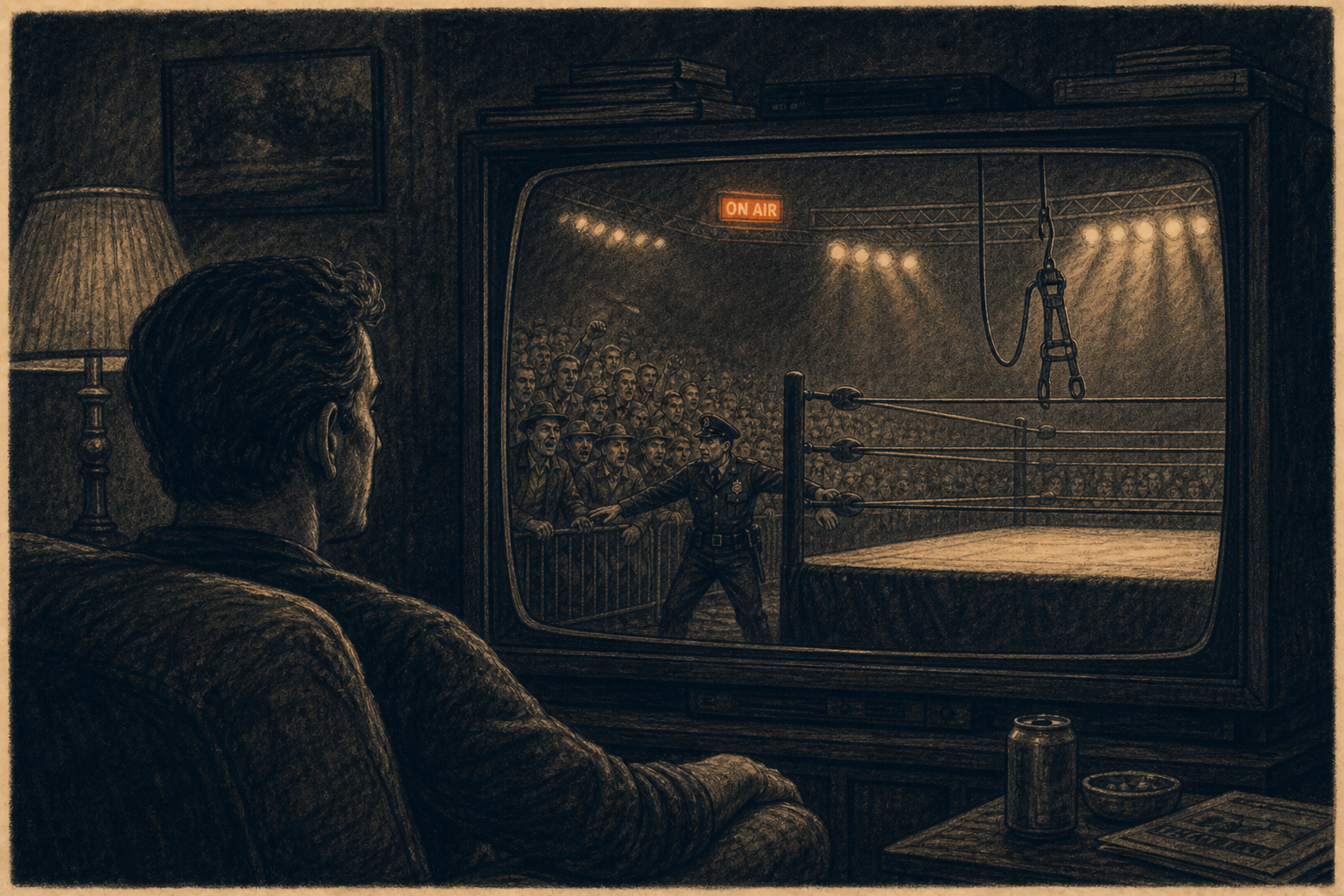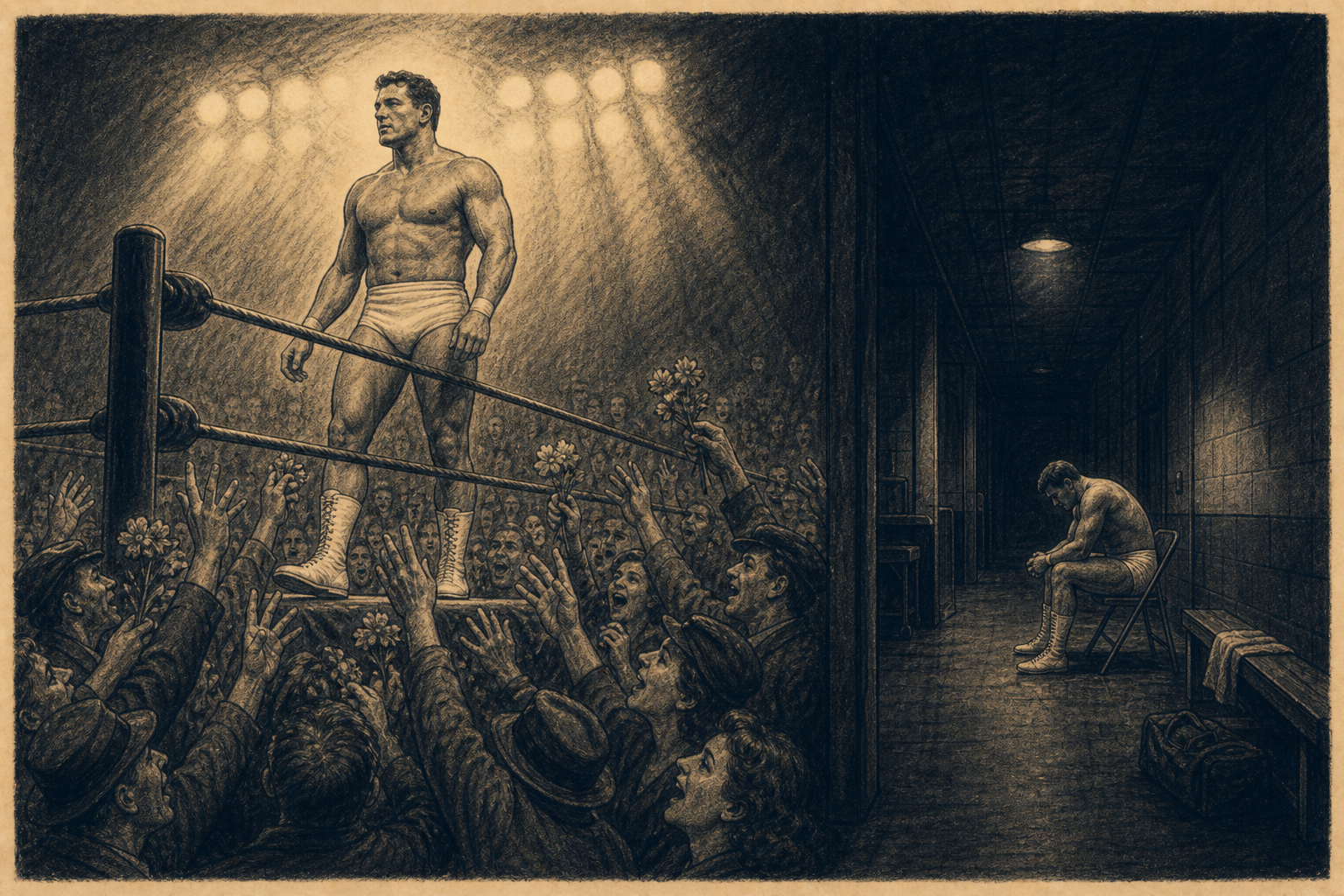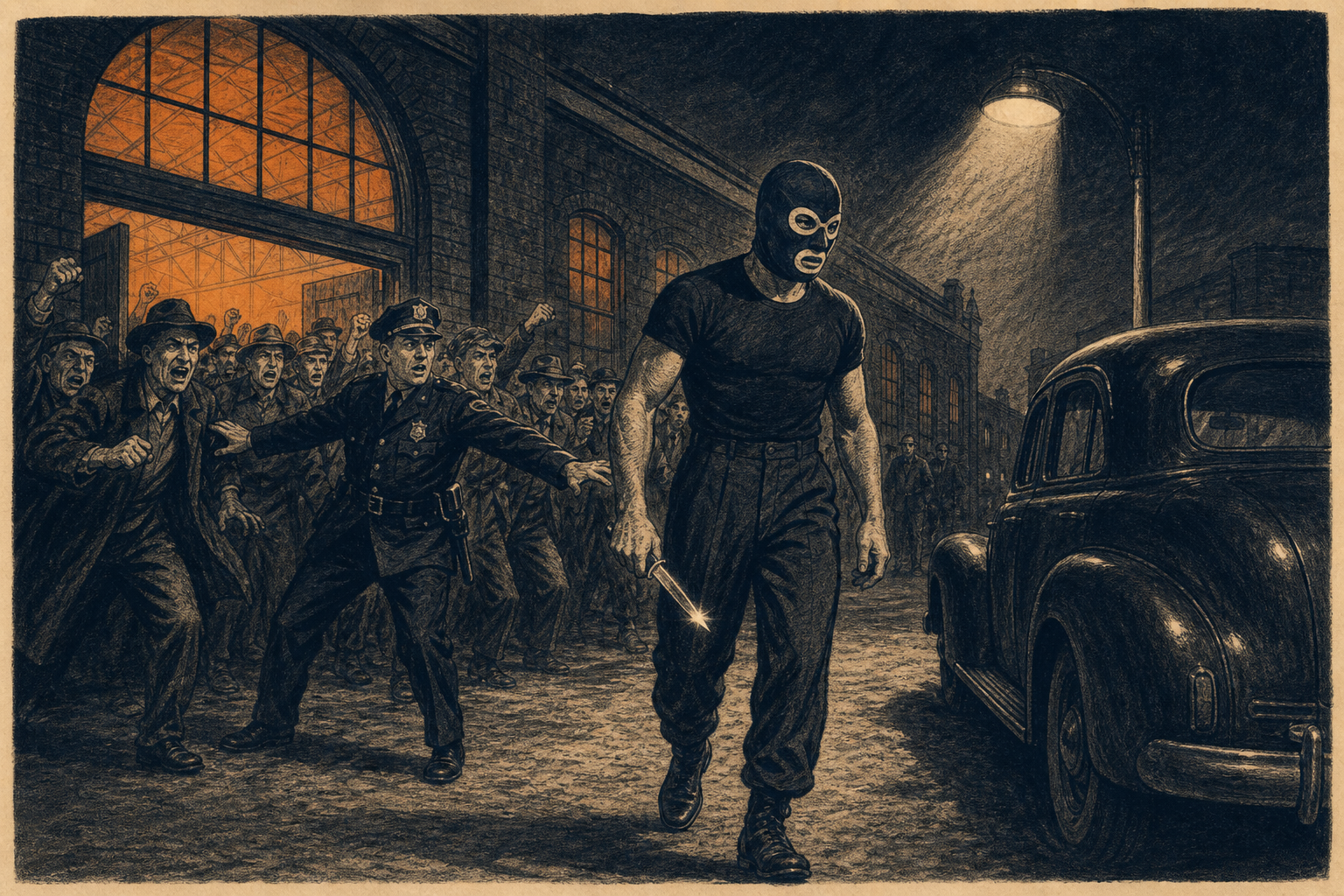
Strip away the costumes and the pyro and professional wrestling runs on a simple engine. You find something the crowd already feels — a grievance, a prejudice, a dislike — and you turn the volume up until two people have to fight. You do not invent the feeling from nothing. You book it.
I wrote about that psychology in The Lost Art of Professional Wrestling: heels rooted in real life, babyfaces the audience can live through, and a finish that pays off the heat. What I did not say there is that the same engine is running outside the ring. I think we are being booked.
Kayfabe holds for a long time when the story still feels like it is on the crowd’s side. It fails when you ask them to believe one swerve too many — especially a swerve about their own lives.
Tell the Truth Until You Can’t
Jim Cornette has retold a piece of booking advice he credited to Jerry Jarrett, the Memphis promoter who understood heat better than most. In a 2013 interview, Cornette put it this way: tell the fans the truth as much as you can, for as long as you can, because then when you work them, they will think A was true, B was true, C was true — so maybe D is true too. Do not give them nonsense from day one. Build trust. Then slide in the little white lie.
That is not a cute insiderism. It is how you get over. I have said as much about CM Punk’s pipe bomb: take something true, tell the truth for as long as you can, and then add drama to turn up the volume. The fans could sense the real frustration. That is why it worked.
The rule has a shadow. If D, E, and F never check out — if the work stops matching what the crowd can see and feel — you spend the trust you built. The marks will keep doing the work for you. The casuals will not.
The 2016 Program
2016 was not year zero for political heat. Willie Horton ads, Swift Boat, Gingrich’s language, birtherism — American politics has booked villains for decades. What was distinctive about 2016 was scale and performance: a national candidate who performed as the heel, a stadium chant that sold a finish the justice system never delivered, and a crowd that wanted to believe the outsider story enough to look past a lot.
Hillary Clinton was a heat character. That is not a vibe. Gallup found that Clinton and Trump finished as the two most negatively reviewed major-party nominees in that poll’s modern history. About a quarter of adults disliked both. It was not a classic face-versus-heel match. It was a double-heel main event, and the crowd still had to pick a side.
Why she carried that heat is not mysterious, and it is not a single cause. Record and dynasty. The email server. Decades of conservative media. Gendered double standards that made every sharpness land harder. Readers can weigh those. What matters for the booking is that the seed was real.
The emails were a real kernel. James Comey told the country that Clinton had been “extremely careless” with classified material on a private server and that no reasonable prosecutor would bring a case. That is A, B, and C — something people could check against their own sense that rules apply unevenly to the connected.
“Lock Her Up” was D. It was the finish they sold without a conviction. The FBI and the Justice Department never put her in a cage. The chant did not need a cage. It needed a heat character and a crowd that had already accepted A through C. That is the Jarrett move. It is not a mystery.
Trump’s unfavorables were worse than Clinton’s. The method still worked. People wanted to believe the outsider story. They looked past a lot because enough of the early chapters checked out against people they already disliked.
Democrats book villains too. “Deplorables.” Trump as existential heel. That is heat. The distinctive claim is not that only one side uses the engine. It is that MAGA identifies with the heel — transgression as strength — while Democratic heat still usually claims the babyface high ground. Trump already spoke the language; he had been on WrestleMania and in the Battle of the Billionaires. That résumé is a footnote, not the thesis. The thesis is the booking.
Business, Not Blood
In the territory days, a feud between Bruiser Brody and The Sheik was often business, not blood: two people making money off heat while cooperating behind the scenes. I used that example in Lost Art. They did not have to be friends. They had to protect the business.
American politics does not need a secret friendship club either. Elite polarization is real. The 1990s cocktail-party Senate is largely dead. They do not have to like each other to extract.
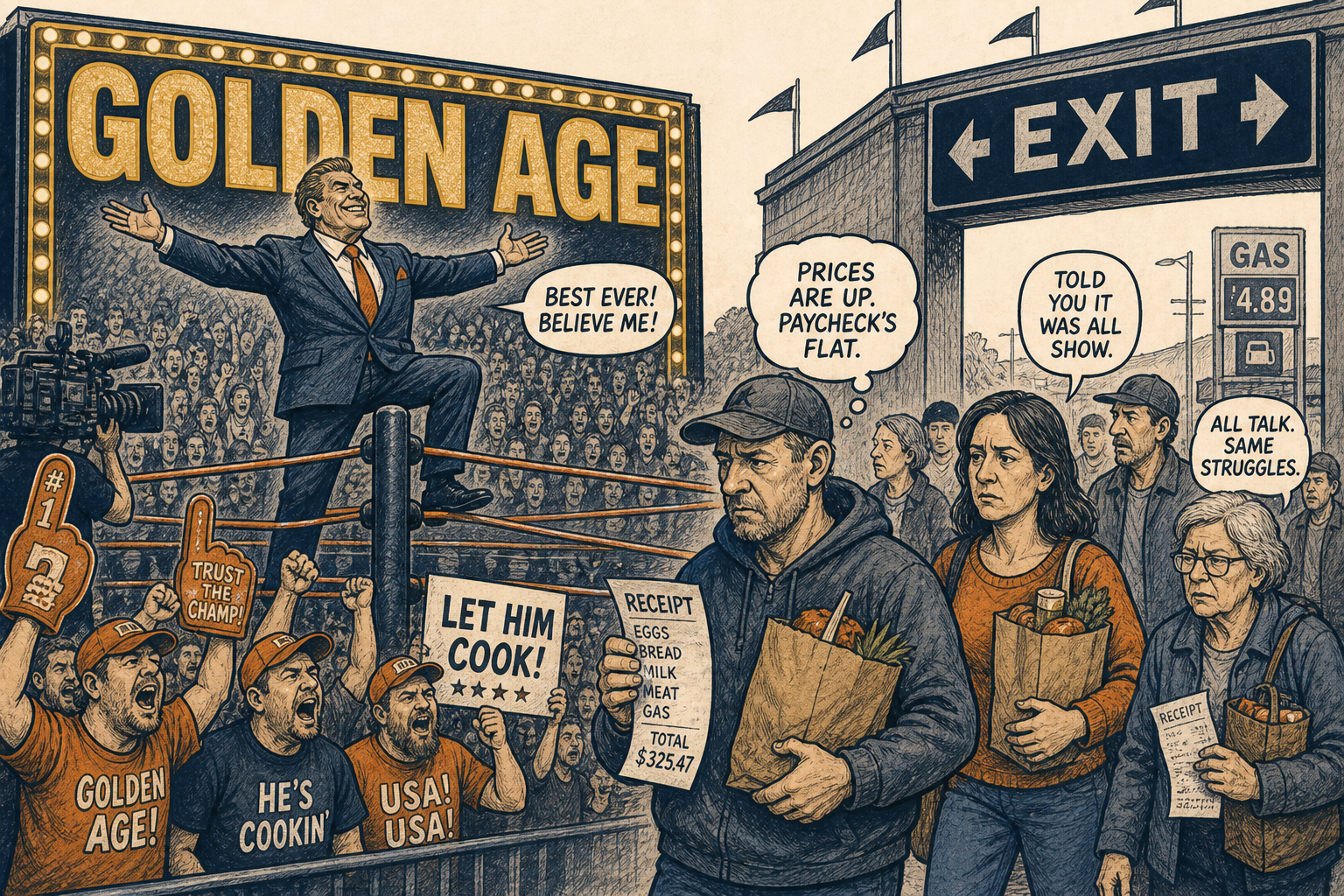
The program is culture-war heat. The business is often omission and class interest. The STOCK Act still barely polices member trading. A full ownership ban keeps dying in committee. In July 2026 the House passed a limited bill that bars new stock purchases — and still does not require divestment. The people who pass the bills, sit on the portfolios, and cut the promos are not living the grocery line. NBC News, a year into the second term, described policy that cut food stamps, Medicaid benefits, and housing assistance while advancing tax and asset-side wins — and a promo that pointed to 401(k) balances and the S&P as proof of a golden age.
They are not suffering the way kitchen-table America is suffering. That is not a claim that every Democrat and every Republican is in on a cartel. It is a claim about aligned incentives among people who own the ledger and never take the bumps.
When Heel Traits Went Mainstream
Territory wrestling used foreign heels, race-coded gimmicks, and cartoon bullies. That was not a sealed “safe place” for hatred. It mirrored prejudice and amplified it. Political spectacle is not new either — Wallace, McCarthy, the long American habit of turning outsiders into heat.
What changed is the container. Heel traits — open xenophobia, bullying, corruption as a flex — moved from “the guy you pay to see get beaten” to “the brand a winning coalition rewards.” In wrestling, when heels get over, nobody wants the blow-off. The business shrinks. In politics there is no ring bell. Voters rewarded the gimmick. That won elections. It is also how you run out of road: there is no comeuppance, only a louder gimmick next week.
The Attitude Era Mistake
I grew up on WWE from 1998 to 2005. The Attitude Era was my wrestling. I am not here to pretend I hated it. Crash TV worked as a ratings weapon during the Monday Night War. Shock, swerves, heat every week. The boom was real. The Monday Night War was anomalous — two national promotions at war, casual millions watching.
Then every week had to be bigger. Shock is not a renewable resource. When WCW died, the competition that had forced the product to stay sharp was gone. Rock went to the movies. Austin was on ice. Variety reported in 2002 that teenage boys were deserting Raw and SmackDown in large numbers. Wrestling did not vanish. It kept passionate fans. It stopped scaling.
Ridiculous and fun can hold a house. That is what the Attitude Era often was. Ridiculous and a lie about the crowd’s own life cannot. That is the hangover I care about — not “edginess killed wrestling,” but overbooking and a product that stopped matching what casual viewers were willing to invest in. I argued the longer version in Lost Art: winking, heel cool, no consequences. The point here is narrower. Heat treated as infinite eventually empties the cheap seats.
The Golden-Age Promo
On January 20, 2025, Donald Trump stood in the Capitol Rotunda and said the line that would define the second-term kayfabe: “the golden age of America begins right now.” He is still cutting that promo. Affordability gets dismissed as a hoax. The State of the Union in February 2026 returned to the same golden-age framing. The crowd can feel food, gas, and housing.
That is the break. Not indictments. Legal heat got the antihero over for a large part of his base — the corrupt authority going after the outsider is a classic booking that protects the character. What the office cannot work is the grocery bill.
Fortune reported in August 2026 that the golden-age economy pitch was not landing with midterm voters. An Economist/YouGov poll in June 2026 found 29 percent approving and 63 percent disapproving of how Trump was handling the economy — a net of −34, the worst of either term. Overall job approval sat in the low thirties by August (Pew; YouGov).
Jarrett inverted. D no longer follows from A through C, because their life is the rebuttal.
This is not a national unmasking. Hardcore MAGA support has barely moved — YouGov still had MAGA Republicans around 92 percent approval while non-MAGA Republicans fell from near-universal approval at inauguration to roughly even. Strong approvers still say the economy is getting better. The marks are doing the work. The edges are not. Passionate fans remain. It stops scaling. That is the Lost Art pattern applied to a presidency.
People who were willing to look past a lot are bouncing because the golden-age promo insulted what they can see. It is not believable. It is not fun. I was never the mark for this program. The question was never whether I could see the work. It was whether his crowd could keep believing. Some of them cannot. The hardest still can. Two months before a midterm is not the time to write a victory lap.
The Volume Knob
Wrestling still has passionate fans. It does not scale the way it did when the story asked casual millions to care. A political movement can live on marks for a long time. It cannot keep the casual millions once the golden-age promo is just another swerve they can feel in their wallet.
You cannot un-book people with a fact-check. Their life is the fact-check. You can notice when A, B, and C are being used to smuggle D — and you can notice when the volume knob has nowhere left to go.
Further Reading
- Gallup — Trump and Clinton Finish With Historically Poor Images (Nov. 2016)
- WrestlingInc — Cornette on Jarrett: tell the truth as long as you can
- Voices of Wrestling — Believability vs. Reality
- Trump second inaugural transcript — “golden age of America begins right now” (Jan. 2025)
- Pew — Trump’s job approval low by historical standards (Aug. 2026)
- Economist/YouGov — Trump job approval falls to 33%
- Economist/YouGov — 63% disapprove of Trump on the economy (June 2026)
- Fortune — Trump’s ‘Golden Age’ economy pitch fizzles (Aug. 2026)
- NBC — Trump policies and the wealth gap
- Variety — Numbers pin down wrestling (2002)
- The Lost Art of Professional Wrestling
- How I Got Into Wrestling