In The Lost Art of Professional Wrestling I argued that the business runs on a simple engine: people pay to see the bad guy get his ass kicked. This is the bill. Heat that actually worked was not a catchphrase. It followed the heel out of the building.
Pat Malone — born Edgar Bryan Davie, billed about 5'11" and 200 pounds — wrestled in the Tennessee territory in the 1940s as The Green Shadow. He came in with Roy Welch and became the foil to Herb Welch, Roy’s brother and the office’s beloved babyface. A Knoxville paper, looking back in 1952, said that for several years the Shadow had been the biggest drawing card on the southern circuit. The name sold the house. Then the house tried to kill him.
He did not need to be a giant. He needed to be dangerous. The hood was nothing special — literally a mask. Dark cloth, holes for the eyes and mouth, a man of ordinary size underneath. It did not make him. The mystery did. The heat did. The town was allowed to believe he was dangerous, which is the same job.
A Mystery With a Body in It
Even a cheap hood turns a man into a question. People will pay to sit with a question. We still do. A loot box works because we romanticize the reward we have not seen; the possibility is what we buy. Offices cash the same appetite when they hype a surprise opponent — whose contract is up, who is a free agent, who is healed — and the guessing is often better than the man who walks out. A Fox panel on The Masked Singer is the tame version. A 1940s crowd treated the question as an insult they could put their hands on.
The Shadow’s office understood the first mystery as product. In Birmingham on August 14, 1944, he beat Mr. X in a mask-versus-mask match. In 1950 he won regional junior and light-heavy titles in Birmingham and New Orleans as the Shadow on the condition the hood came off after. The reveal was the blow-off. You do not spend that kind of ending on a man who was never a question.
There is a second mystery, and it is the one that still works after you know his name. How much of the danger was an act. How much was Pat Malone. You do not have to be a mark to sit with that. You have to take the story seriously enough that the gap matters.
The shape of the thing was a mystery novel with a body. Slow. Chapters that remembered last week. Physical stakes so the emotion was not only in the head. Nashville had the patience to write it that way — months, years, the same men in the same town. Most promoters now would dump the novel in a single episode of free television and wonder why nobody riots. You cannot get a parking lot from a spoiler.
The Scene Paragraph
J.R. Lind, in a 2019 Nashville Scene history of the city’s wrestling, wrote this:
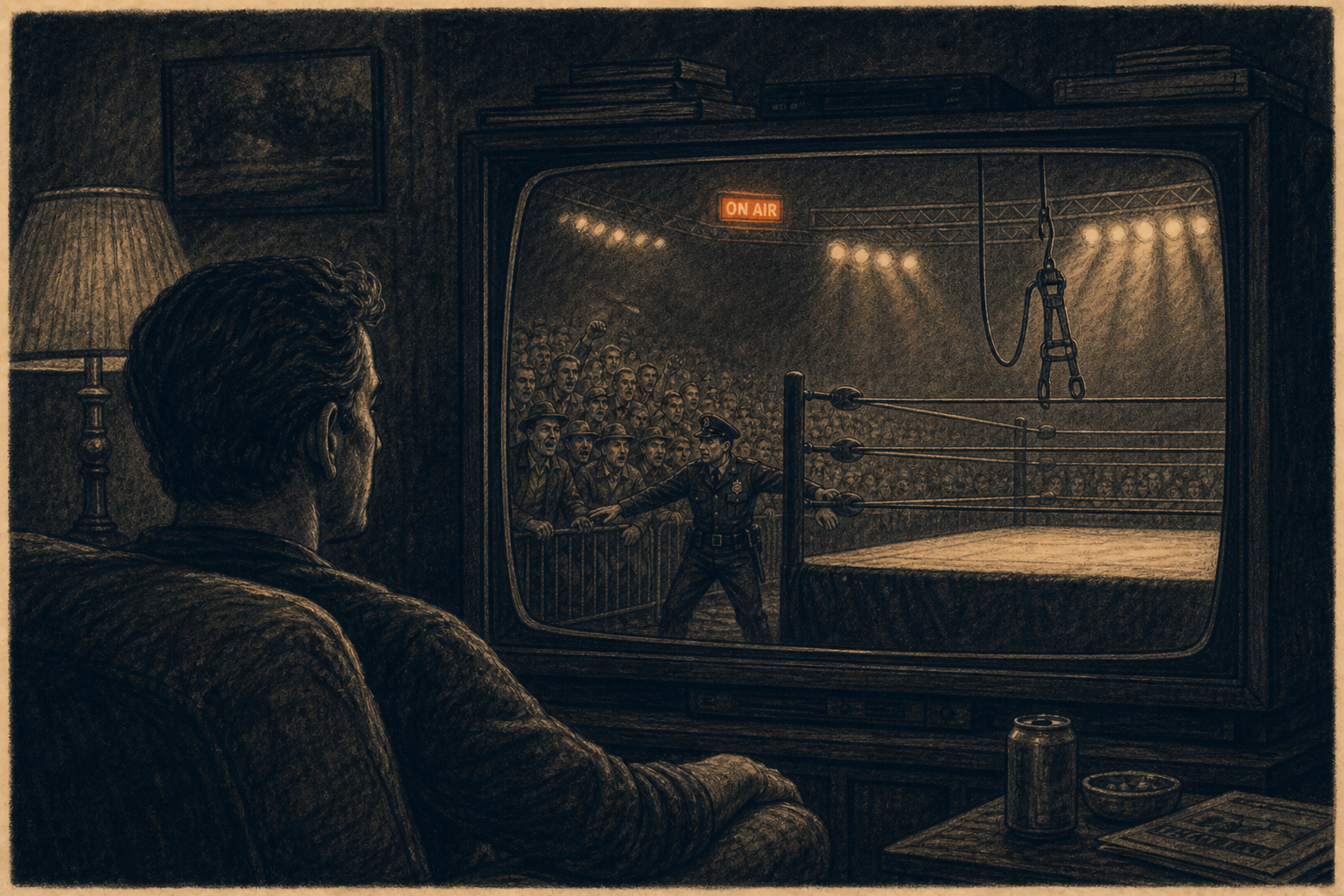
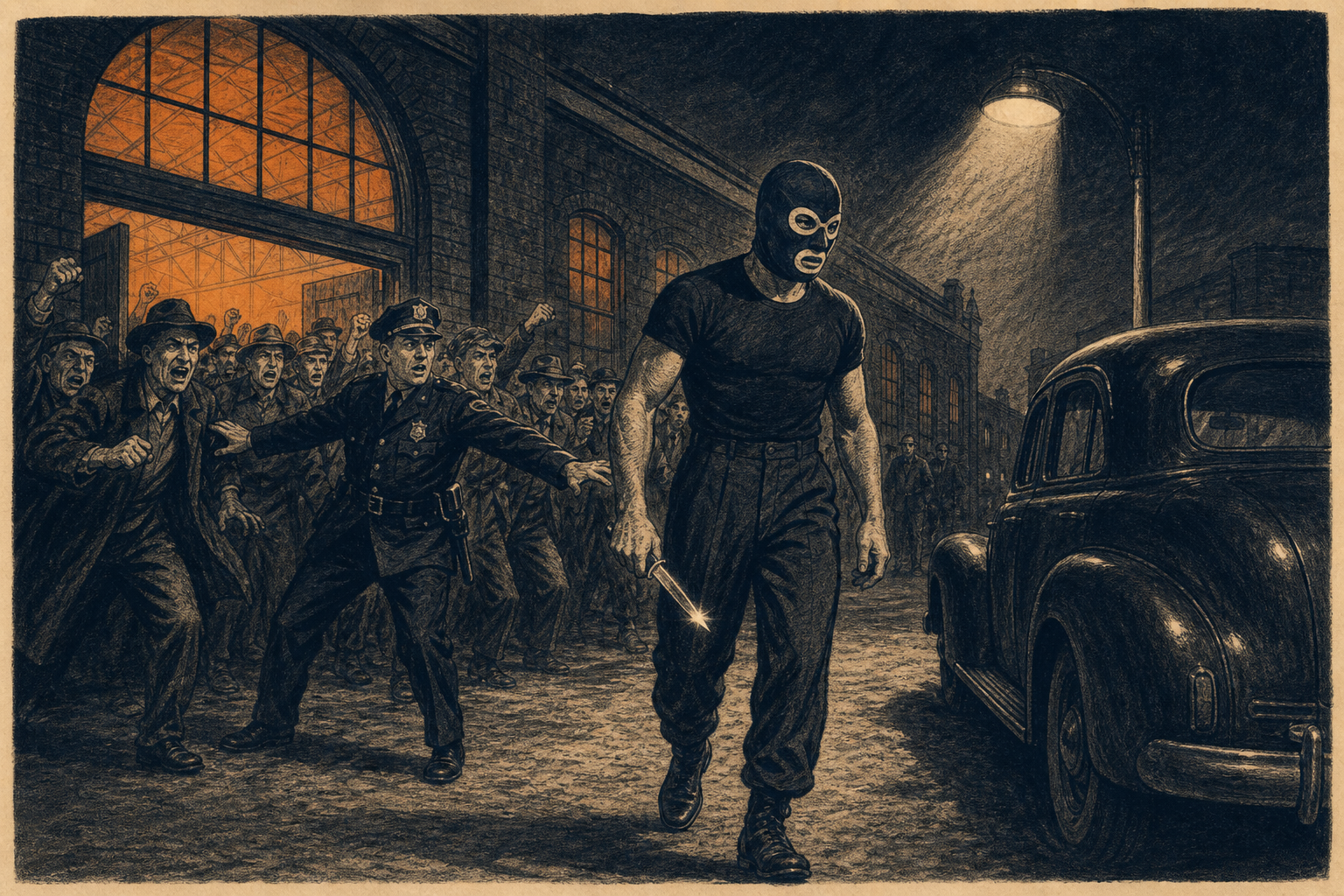
The Shadow generated so much heat with the live crowds that riots and in-stand fights were de rigueur — to the point that Nashville police officers who worked security at the events demanded a raise from the promoters. In one famous incident, a fan jumped into the ring after a Shadow victory and pulled a knife. The Shadow, unimpressed, pulled his blade and chased the interloper out of the building. Once police and the Shadow’s fellow wrestlers arrived, the wrestler had the fan pinned to the ground, knife at his throat, and was making to decapitate him.
Sit with that. Two things are doing different work. The cops demanding a raise is the institutional version: heat so routine the city priced it. The knife is the personal version: a man in a hood won, a fan decided that was worth dying over, and the hooded man agreed.
Lind does not source the incident in the piece. Jim Cornette tells what is almost certainly the same night, as he heard it from Malone’s second wife, Sammy. In Cornette’s version the Barlow lived in the boot for fans, not locker-room double-crosses. The fan stabbed him. The chase ended in the parking lot. They pulled Pat off while he was sawing left to right. Cornette flags wrestler’s exaggeration. Sammy told it laughing.
I am not going to mash those tellings into one. The laugh is the bitter part. This was the job, and the people who loved him treated a near-beheading as a story you tell over dinner.
It was not one wild Nashville night. In Knoxville, after a Shadow win, fans threw bottles, pieces of the balcony railing, and seat backs. The fight spilled onto Gay Street. Dynamite Lay went to the hospital with an injured arm. That is in Tim Dills and Scott Teal’s Knoxville: 1905–1960. Proof the heat traveled.
The Job Was the Danger
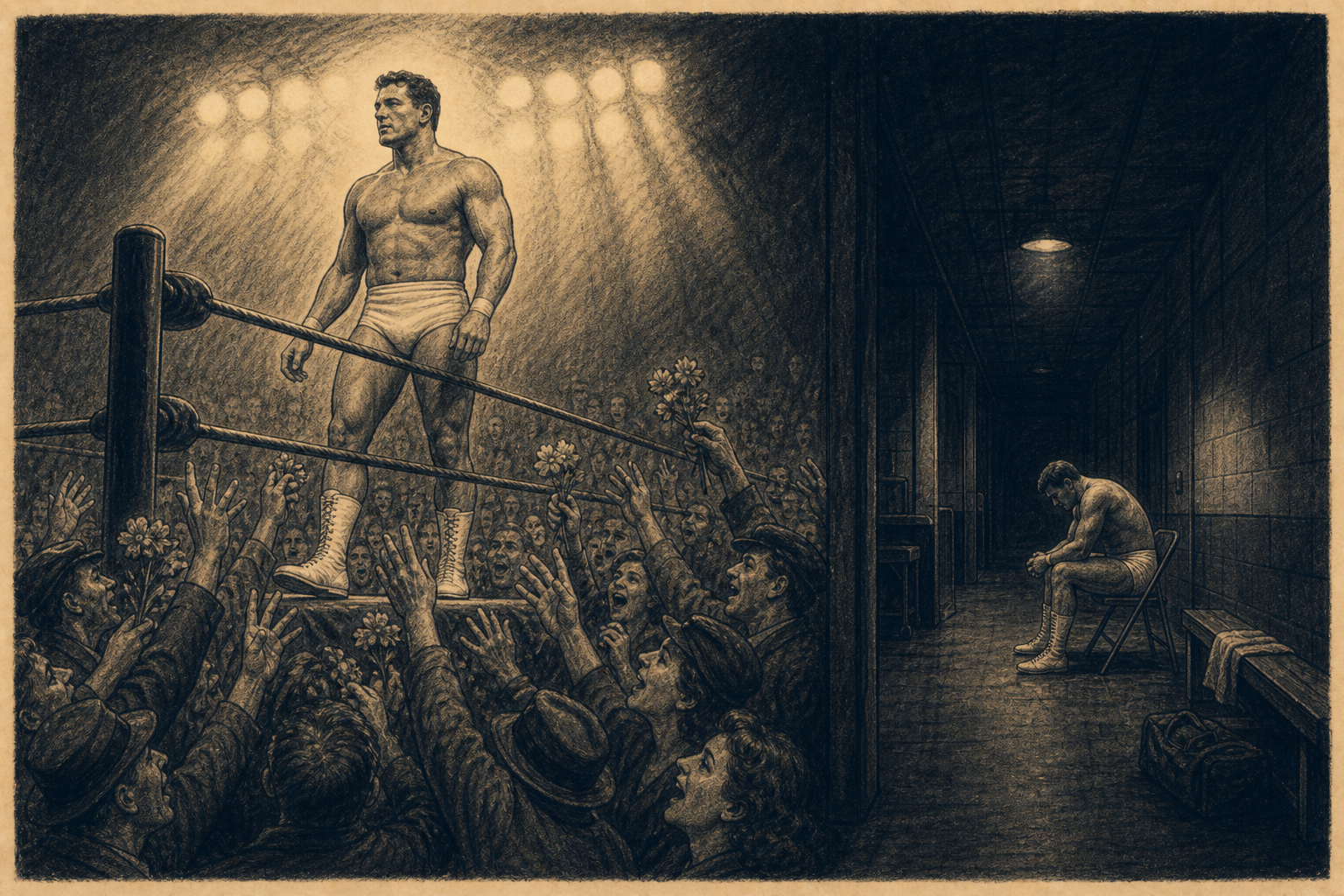
Being a heel in a territory was a living. It was also a sentence. You drew money because people wanted to hurt you, and then you had to get to the car. The bitterness is that the job worked. The sweetness is that the job worked.
A hood looks like a way out of that sentence. Hide the face and you can eat breakfast as Pat Malone. That is the promise of every mask: the gimmick stays in the ring, the man goes home. It is a lie on the walk to the sedan.
The hood did not make him safer. It made him findable. In a Hippodrome crowd there is one man in a cheap dark hood with rings around the eyes. Everyone in the building can pick him out of a riot. He cannot pull it off on the way out without handing the town the blow-off for free — the mystery was the product, and a fan with a fist would have stolen it. So he walked out as the question they wanted to answer themselves. Half-blind, sweating through cloth, wearing the thing they hated, and carrying a Barlow because cloth does not stop a knife.
That is the cost. Not the costume. The costume is cheap. The cost is inhabiting a man people have been given permission to touch, in a building close enough to touch him, and staying in that man until the door shuts on the car. Nashville police wanted more pay to stand in the same room. Malone kept steel in the boot. Those are the same fact from two sides of the aisle.
Nashville made that fact profitable. Most offices sold the babyface. This one sold the heel. Herb Welch was civic — more than 200 sellouts over three decades — so cheating him was cheating the town. Roy promoted, Herb faced, Malone came in with Roy: the office owned both sides and could keep a grudge warm for years. On June 1, 1948, the Shadow beat Herb for the Tennessee World Junior Heavyweight title and dropped it thirty-five days later. The belt was proof of the heat. It was not the heat. He never chased the traveling heavyweight title. He sat at the top of a 190-to-200-pound class that was the Southern main event. Vince later sold size as the law of drawing. That was a television shortcut. Nashville had already disproved it. A chicken-shit heel who should not be beating your guy can be easier to hate — and easier to reach.
Forty years later, Jim Cornette was still paying the same bill in Mid-South. In Little Rock, Barton Coliseum cops had new vests; an officer gave him one; he wore it under his clothes because the building might turn. Hercules Hernandez walked him out. After Bill Watts and the Junkyard Dog stripped him in New Orleans, they were still fighting fans on the way back. Cornette’s face was the gimmick. Malone’s was hidden. The hood did not commute the sentence. It only changed which part of the man the crowd got to grab. Both versions of mystery — who is that man, how dare that man — end in the same place. You do not go out in public as yourself. When you do, you bring protection.
Why the Room Got That Hot
Malone’s Shadow run is wartime and immediate postwar, about 1944 to 1950. Not “between the wars.” The room was World War II, then demobilization, then the first years of the Cold War.
Do not hang this on “the men were fired up and looking for trouble.” That is atmosphere, not the engine. Wrestling riots happened before the war and long after it. In Kansas City in 1940 a crowd mistook an iron cross for a swastika and tore the building up. Toronto built a ramp in 1948 because Nanjo Singh could not get back to the locker room. A Charlotte crowd cut Frank Hewitt under the ring in 1947. Cornette was wearing a borrowed vest in 1984. Veterans did not invent heat. A protected fiction in a close building did.
Kayfabe was intact. Newspapers covered it as sport. There was no national confession. You could believe, or perform belief, without being the joke. Once the industry winks, you do not riot at a wink.
It was live only. Nashville does not get weekly wrestling television until the mid-1950s. The only Green Shadow you got was the one cheating Herb Welch in a hot roller rink. Heat had nowhere to dissipate.
The Hippodrome was a rink and a gym, not a modern arena with a tunnel. Fans were close. Chairs were loose. Drink was in the room. Architecture made the riot possible.
And heat was the paycheck. Before television money, the more they hated you, the more they bought a ticket next Tuesday to see you lose.
The war was gasoline. A Southern crowd had just spent years being told some men were enemies you were allowed to hate. After the war, Axis heels cashed that in directly. The Green Shadow was not one of those. He was a mystery heel. The war did not write his gimmick. It made the room more willing to treat a public insult to the local hero as something you put your hands on.
Why now is cooler is the inverse, not that people got nicer. The product tells you it is fake. Heels sell shirts. You watch them be decent on a podcast. Arenas are built so you cannot reach anyone. The legal cost of rushing a performer is real. And the babyface is rarely your guy in your town anymore. National television dissolved the insult.
The booking is the center. A civic babyface, a long memory, and a heel they sold as the star. Malone and the room supplied the weather. Without the center you get a good match. With it, you get cops asking for a raise — and a man who cannot take the hood off until he is in the car.
The knife night is a flywheel, not the origin. You do not get that night without prior heat. You get cheaper heat after it, because the town now believes he might actually cut you. I am not going to pick a verdict on how much of the knife was work. The stories do not. The fun is the gap.
The Novel, Then the Bill
This was a mystery with a slow build that made sense — chapters, the same cast, a body when the emotion needed one. Most promoters now would tell the whole thing on one episode of free TV and call it a program. You cannot get cops asking for a raise from a spoiler.
Heat is the product. The product follows you home. Fans were not dumber. The story was given time.
There is another cage, inverted: the babyface who has to be the golden boy everywhere, who cannot have a bad night in public either. That is a different essay. This one is about the man in the hood, and what it cost him to be believed.
Further Reading
- J.R. Lind — “The Greatest Wrestling in the History of the World” (Nashville Scene, 2019)
- Vendetta — Cornette on Malone, the Barlow, and the parking lot
- Greg Oliver — Pat Malone biography (Slam Wrestling)
- Wrestling Inc — Cornette’s Little Rock vest
- Mike Mooneyham — Midnight Express in Mid-South
- Jim Cornette, Heroes and Friends (Malone chapter)
- Tim Dills & Scott Teal, Knoxville: 1905–1960 (Crowbar Press)
- Scott Teal & Don Luce, The Greatest Wrestling Ever in the History of Nashville, vol. 1 (Crowbar Press)
- Wrestling-Titles — Tennessee World Junior Heavyweight