Open a feed long enough and you will be told the country went left. Universities. HR departments. Prestige newsrooms. “Woke.” The story is weather: ambient, inevitable, already decided.
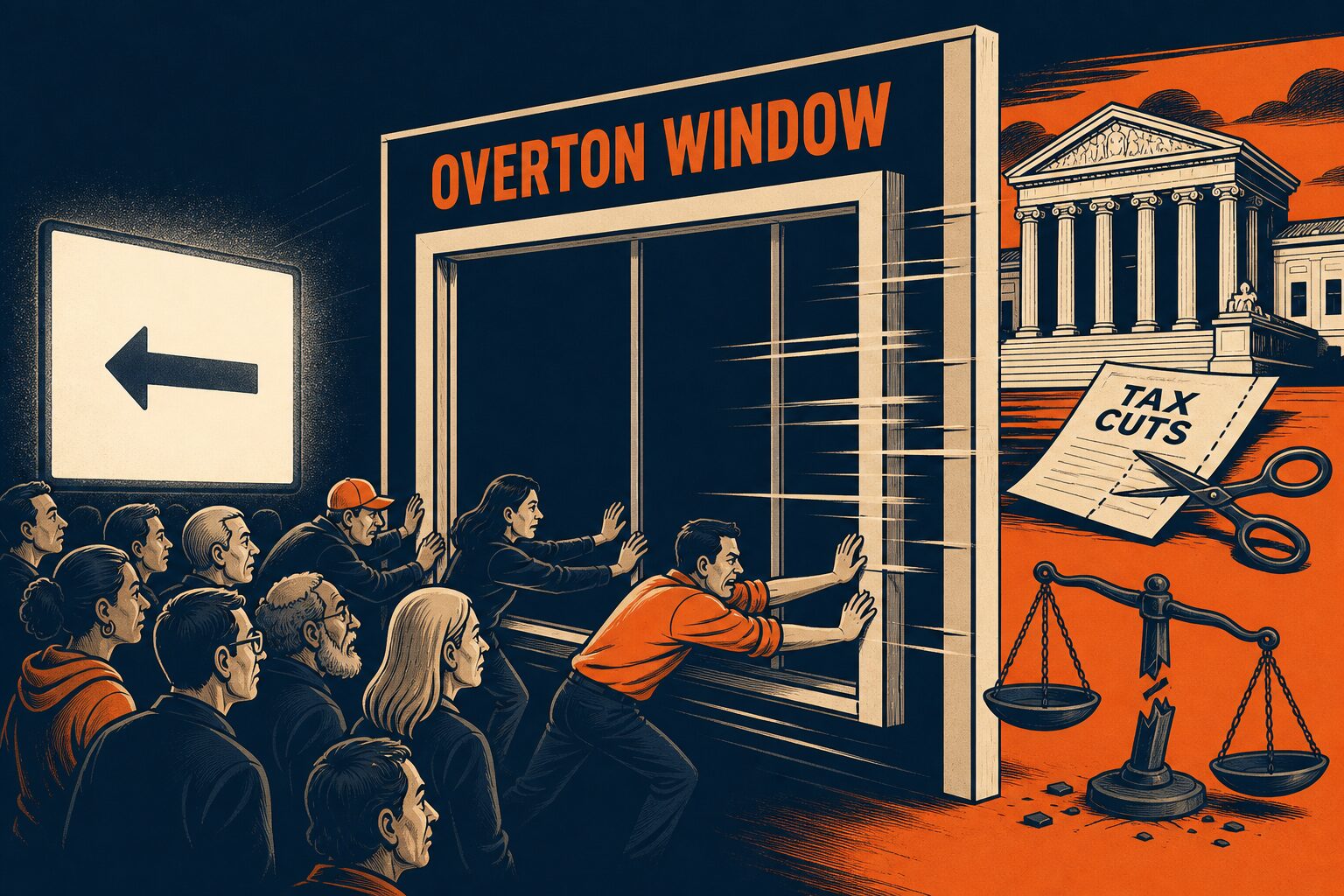
I am not going to pretend campuses and prestige media lean right. They do not. Cultural institutions and the median legislator are different questions. Roll-call ideology, who got driven out of the Republican Party, and what counts as unsayable policy all point the other way. The Overton window moved right. The coalition that pushed it still sells Barry Goldwater on the brochure. Look at the ledger and the brochure is a costume. Start here with the measurement and the stray — churches and outcomes follow in the rest of the series.
Be Fair: Goldwater Believed It
Barry Goldwater looks like a true believer, not a Bond villain who invented a fake 1960s con. He lost forty-four states in 1964 in part because he would not sand the edges off. “A choice, not an echo.” “Extremism in the defense of liberty is no vice.” He voted for the 1957 Civil Rights Act and against the 1964 Act on Titles II and VII as property and federal-power grounds — later calling that vote one of his great regrets. He desegregated his family’s Phoenix stores. He was not a Falwell culture warrior. In 1981 he told the Senate he would “fight them every step of the way” if the Moral Majority tried to dictate morals “in the name of conservatism.”
The later movement outgrew and used him. Nixon’s Southern Strategy, Paul Weyrich hunting for a wedge that would actually mobilize people, Roger Stone’s dirty-tricks through-line from Goldwater volunteer to Trump — those are instrumental layers. People can believe and calculate. A sincere constitutional argument can still assemble a segregationist electoral coalition. That is a different charge than “Goldwater was lying.”
Failed policy is not proof of malice. Where someone said the quiet part — David Stockman on supply-side, Weyrich on the IRS wedge — we will name it. Where we only have wreckage, we argue from wreckage.
The Measurement
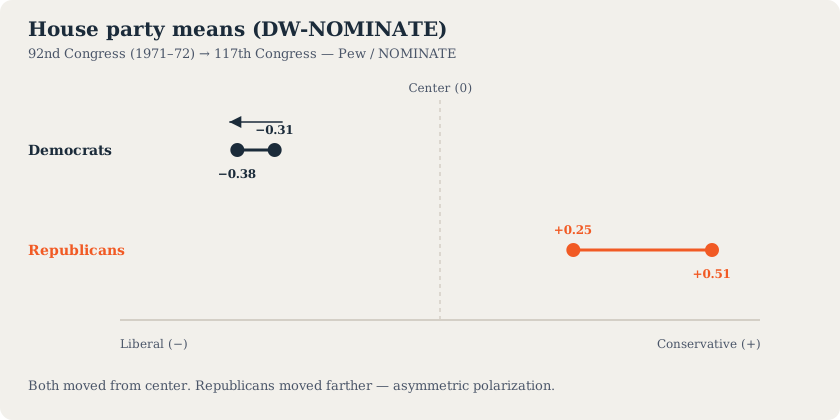
Pew’s analysis of DW-NOMINATE scores — roll-call ideology comparable across decades — is the spine. Between the 92nd Congress (1971–72) and the 117th, both parties moved away from the center. Republicans moved more. House Democrats went from about −0.31 to −0.38. House Republicans went from about 0.25 to nearly 0.51. Southerners went from under 15 percent of the House GOP caucus to about 42 percent, and Southern House Republicans became the most conservative bloc.
That is asymmetric polarization. Thomas Mann and Norman Ornstein documented the institutional consequences: gridlock as a feature when one party treats compromise as betrayal. You do not need vibes. You need the votes.
Why It Feels Like the Opposite
Concede the objection in one breath. Campuses leaned left. Prestige print and network news still lean left. NYTimes.com still leads digital visits. Democrats use a wider news diet — CNN, the networks, NPR, the Times. That is the “MSM” people mean.
Then look at the diet Republicans actually live in.
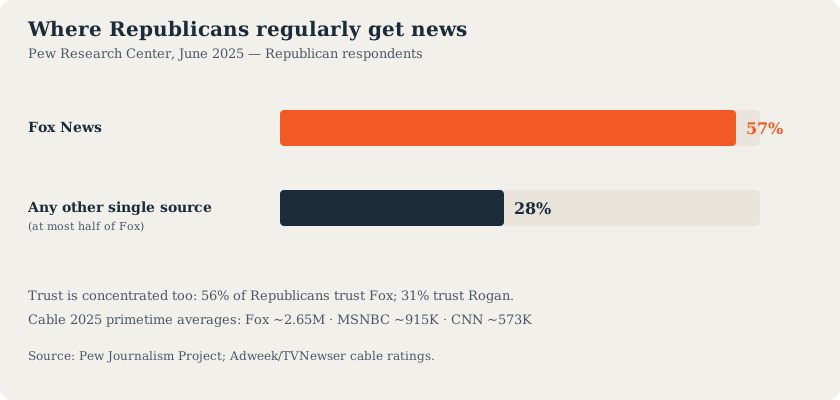
Pew’s June 2025 report: 57 percent of Republicans regularly get news from Fox News — at least double any other source they were asked about. GOP trust is concentrated: 56 percent trust Fox; 31 percent trust The Joe Rogan Experience. Fox has been number one in cable news since about 2002. In 2025 it averaged roughly 2.65 million primetime viewers against MSNBC at about 915,000 and CNN at about 573,000. Talk radio has been conservative-heavy for decades. Newsmax, Daily Wire, Breitbart sit on the Republican side of Pew’s map.
Conservative media does not own the entire press. It owns the partisan TV / talk / podcast funnel that produces the “country went left” feeling. People choose Fox and Rogan. Outrage gets the clicks. The loop repeats that they are surrounded by the left — which is how a rightward Overton window can feel like a left-wing takeover.
Do not hang this on a cartoon “algorithm radicalized everyone equally.” Meta’s 2020 Facebook and Instagram experiments found that swapping algorithmic feeds for chronological ones did not change polarization. Short-term YouTube “rabbit hole” studies are modest. Selective exposure and a concentrated diet do more work than a magical filter bubble.
X is the directional exception worth naming. A 2026 Nature field experiment (Gauthier and coauthors) assigned U.S. users to algorithmic or chronological feeds for about seven weeks in summer 2023 — after Musk’s takeover. Switching to the algorithmic “For you” feed increased engagement and shifted attitudes toward more conservative policy priorities, harsher views of the Trump investigations, and more Kremlin-friendly takes on Ukraine. The algorithm promoted conservative content and demoted traditional media. Users followed conservative activist accounts and kept following them after the algorithm was switched off. Switching the algorithm off did not unwind the shift. That is personalization with a direction, not both-sides symmetry.
Trump’s digital play fits the same map: 2016 Facebook and Twitter conflict framing; 2024 less Meta ad spend, more podcasts and streaming, plus a friendly X.
One courtroom footnote, because the meme is wrong. Fox did not tell a court “we are entertainment, not news.” In McDougal v. Fox News (S.D.N.Y. 2020), Fox’s lawyers argued — and Judge Mary Kay Vyskocil held — that the “general tenor” of Tucker Carlson’s show means a reasonable viewer understands he is engaging in “exaggeration” and “non-literal commentary,” not “stating actual facts.” When stolen-election claims ran as news and internal messages showed they knew they were false, Fox paid Dominion $787.5 million. Commentary when convenient. News when selling panic. They cannot have both.
The Exile Class
If the party had not moved, center-right Republicans would still be welcome inside it.
David Jolly left the GOP in 2018, registered as a Democrat in April 2025, and is running for Florida governor. Charlie Crist switched. Jeff Flake left the Senate rather than bend. Liz Cheney lost her primary. Adam Kinzinger left Congress. Justin Amash left the party. The Lincoln Project and The Bulwark are Never-Trump conservatives whom right-wing media treat as left. Moderates do not “evolve” out of existence. They lose primaries or quit. That is evidence of a party shift.
Barack Obama, December 2012, Univision: his policies were “so mainstream that if I had set the same policies that I had back in the 1980s, I would be considered a moderate Republican.” He was answering socialism charges. The quote lands harder when you remember what “moderate Republican” meant in the 1980s — and what the exile class looks like now.
How a Window Works: Obamacare
Here is the load-bearing exhibit.
Stuart Butler’s 1989 Heritage Foundation brief, “Assuring Affordable Health Care for All Americans,” proposed an individual mandate as the conservative alternative to employer mandates and single-payer — a way to stop free riders. The 1993 HEART Act (Chafee/Dole and roughly twenty Republican senators) carried the architecture. Mitt Romney signed a cousin of it in Massachusetts in 2006. Obama ran against the mandate in 2008, then adopted the market design: private insurance, subsidies, exchanges, a mandate. Heritage later distanced (Butler, “Don’t Blame Heritage,” 2012). Do not say Heritage wrote Obamacare. Say the architecture was what center-right reformers offered so the country would never have to debate the peer-country model.
In the 2009–10 governing window — the only time a president and Congress could have put single-payer on the table — they excluded it. Obama said we are not starting from scratch. Senate Finance Chairman Max Baucus declared it off the table. Activists who interrupted a hearing to demand a seat for Medicare for All — the “Baucus 8” — were arrested. The public option died for Joe Lieberman and centrist votes. Zero Republican votes for the Affordable Care Act. Sarah Palin’s “death panels” became PolitiFact’s Lie of the Year. The substitute was still sold as Bolshevism. Repeal nearly succeeded in 2017.
This is how a window works. You never debate the left option if the center-right option is already “socialism” — and a personalized media diet will keep repeating that it is. Every other rich democracy has a statutory path to universal coverage. The ACA reduced the uninsured. It did not close the peer-country gap. That story continues in part three.
The Stray: Budget, Tariffs, Law and Order
Modern leaders still name-check Goldwater. Then they drop his limits.
The budget ladder
Goldwater’s rule in The Conscience of a Conservative: “spending cuts must come before tax cuts. If we reduce taxes before firm, principled decisions are made about expenditures, we will court deficit spending.” He attacked Eisenhower’s deficits. He voted against the Kennedy tax cuts of 1963. He was a defense hawk — “cut everything” is a cartoon of him — but the spend-first rule was the brand.
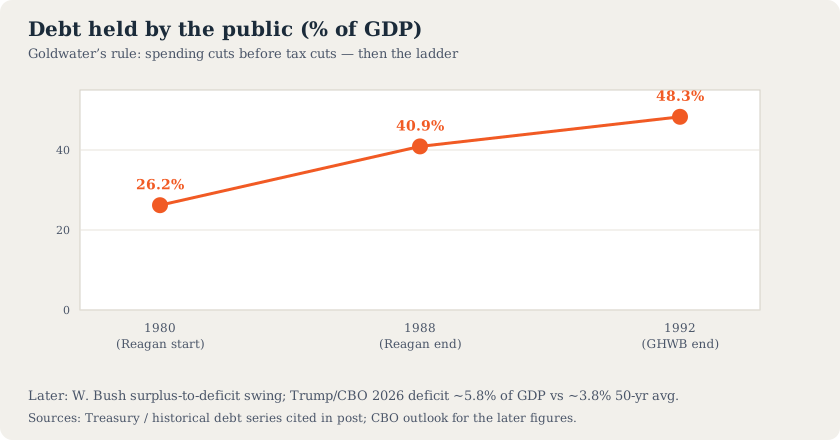
Reagan already broke it. Top rate from 70 percent toward 28 percent, defense up, domestic not cut enough. Debt held by the public went from about 26.2 percent of GDP in 1980 to 40.9 percent in 1988. David Stockman told William Greider in The Atlantic (December 1981) that Kemp-Roth “was always a Trojan horse to bring down the top rate” — “It’s kind of hard to sell ’trickle down,’ so the supply-side formula was the only way to get a tax policy that was really ’trickle down.’” George H.W. Bush had already called it “voodoo economics.” Do not pin Laffer-curve branding on 1960 Goldwater. He was a balanced-budget fiscal conservative. Supply-side is late-1970s Reaganomics.
George H.W. Bush is the control case. He inherited the hole, then signed the 1990 budget deal that raised taxes. Debt as a share of GDP kept rising — to about 48.3 percent in 1992 — and the coalition treated the tax increase as betrayal. Fiscal honesty became a career-limiter.
George W. Bush certainly did. He inherited a surplus path (CBO, January 2001). CRS found legislative changes — 2001 and 2003 tax cuts, Iraq and Afghanistan supplementals, Medicare Part D — accounted for about two-thirds of the surplus-to-deficit swing. Even if the economy had matched the 2001 forecast, the budget would still have been in deficit from 2003 to 2007. Debt held by the public roughly doubled in dollars.
Trump made the violation the program. TCJA without matching spending cuts. The 2025 reconciliation law permanently extends the 2017 rates. CBO’s February 2026 outlook: a 2026 deficit of about $1.9 trillion / 5.8 percent of GDP against a fifty-year average near 3.8 percent, with that law adding an estimated $4.7 trillion to deficits over ten years. COVID outlays were bipartisan. Clinton produced surpluses — mention that so this is not “everyone spends.” The indictment is the Republican sequence after Goldwater: tax cuts first, bills later, interest compounding, while still claiming the balanced-budget mantle.
Tariffs
Goldwater’s 1964 campaign booklet: “Vigorous international trade is vitally important.” Buying abroad “helps raise our living standards.” “Trade should be a two-way street.” The answer is competitive ability in free enterprise, not “the restriction of American ingenuity.” He backed a free-world common market as a force against communism. Reciprocity, not a wall.
Reagan, April 25, 1987 radio address: imposing tariffs is a step he is “loath to take” because “over the long run such trade barriers hurt every American worker and consumer.” The Japan semiconductor duties were a “special case” to enforce an agreement, “not begin a trade war.” Smoot-Hawley is the ghost in that speech. He used Harley-Davidson Section 201 and auto/steel “voluntary” restraints — tactical exceptions he framed as temporary. Trump inverted that: broad, lasting tariffs as the doctrine. The party made his protectionism the brand after 2018. By August 2026 some Republicans were furious over new Canada tariffs heading into midterms. They made the brand, then flinched when grocery prices showed up in the ads. Not eternal unanimity. The stray still stands.
Law and order — and character
Nixon ran on “law and order.” Do not hang a halo on that brand; it was racially coded. The point is the standard the party claimed, then dropped.
On August 7, 1974, Goldwater, Senate Republican Leader Hugh Scott, and House Republican Leader John Rhodes told Nixon House impeachment would be nearly unanimous and he had maybe fifteen Senate votes for acquittal. Nixon resigned the next day. Goldwater was the conservative who delivered the news. Ford’s pardon of Nixon is a caveat, not an equivalence.
After two impeachments, a civil sexual-abuse finding (E. Jean Carroll), a New York falsifying-records conviction tied to the Stormy Daniels hush payment, and January 6, the same party made Trump the nominee again. He is still in power.
January 6 was the Capitol, not the White House. A crowd assaulted police and broke into the building. More than a hundred forty officers were injured. Proud Boys and Oath Keepers leadership drew seditious-conspiracy convictions. On day one of the second term, Trump issued clemency for roughly 1,500 January 6 defendants. The law-and-order party mass-pardoned the riot.
Pardons that appear pay-to-play: write as a documented pattern, not a courtroom verdict. First term: Stone, Manafort, Flynn, Arpaio. Second term: ProPublica found most of roughly 1,600 clemencies did not go through the Office of the Pardon Attorney; January 6 is the bulk; the rest skew allies, donors, and culture-war figures. Reporters describe intermediaries charging hundreds of thousands to millions to get a case in the door. Trevor Milton’s pardon wiped restitution after large Trump-aligned donations. The Changpeng Zhao / Binance pardon sits next to Trump-family crypto interests; Binance denies impropriety; Democrats called it pay-to-play and opened inquiries in 2026. People have always hired pardon lawyers. Clinton’s Marc Rich pardon was ugly. The change is volume, bypassing DOJ process, January 6 as a bloc, and a visible clemency market.
Affairs: JFK and Clinton happened. The GOP still sold family values and impeached Clinton over Lewinsky. Access Hollywood briefly made Paul Ryan cancel a joint event. They kept Trump. That is the stray from 1970s Republican shame — not a claim that Democrats were monks.
They made Nixon resign. They would not make Trump. Goldwater was in the room for the first one.
The Dual Loss — Then Why Keep Buying It?
Do not write “conservatives got nothing.” Split the coalition.
Who got paid: the donor and business wing (top-rate cuts, TCJA, the 2025 extension); Federalist Society and the courts (Dobbs, the durable win); gun politics; immigration-as-theater and some enforcement; anti-woke cultural combat as a media product.
Who did not: Goldwaterites who wanted balanced budgets, free trade, church/state separation, character, and law-and-order that includes their president; working-class Republicans sold wages, cheaper goods, and dignity — and who instead got a K-shaped economy, tariffs that act like a grocery tax, and no peer-country floor on healthcare or leave (part three). Evangelicals got judges and Dobbs and a leader who fails the family-values test they used on Clinton. Part two is how that bargain was built.
The pattern is not “the right won and everyone is happy.” It is: the country moved right, the brand was gutted, a few factions cashed in, the brochure voters did not.
So why does the coalition still hold?
Negative partisanship. Voting against Democrats more than for a platform. Attacks and indictments read as the out-group cheating, which tightens loyalty.
Sorted identity. Lilliana Mason’s Uncivil Agreement: party as mega-identity. Policy failure does not un-merge race, religion, and place into a new team.
The media diet. Fox concentration plus algorithmic reinforcement. The feed delivers winning the argument and being under siege every day. That can feel like getting what you wanted when the ledger does not.
Status and recognition. Arlie Hochschild and Katherine Cramer: pride, shame, and who “cuts in line” — not Goldwater’s budget rule. Trump sells fight and recognition. The product is the fight.
The two-party trap. Goldwater conservatives who leave become Jolly, Amash, Cheney — they exit the viable coalition. Primaries punish the rest.
Narrow wins get generalized. One Supreme Court seat becomes “we are winning America,” and the loop repeats it.
Fear — two kinds. Out-group threat (the left, replacement stories) is a real on-ramp. The fear that yanks you back in after you notice the ledger is often being the odd one out: church, family, the group chat, the primary. Dan Kahan’s identity-protective cognition is about protecting standing in the group. Elisabeth Noelle-Neumann’s spiral of silence: people fear isolation, scan which views get you frowned at, and shut up; silence makes the majority look bigger. Intra-party research finds Americans overestimate how hard co-partisans will punish dissent. The conversion line — “if you notice, you’re with them” — fuses odd-one-out fear into existential out-group fear.
Do not hang this on the TED-talk “backfire effect.” Corrections often make people a bit more accurate about a specific claim. Accuracy fades. Elite and media cues overwrite it. Candidate favorability often does not move. Nyhan, Porter, Reifler, and Wood: people take fact-checks literally but not seriously. Facts can land. They often do not unhook the team.
Do not write that support always spikes right before a bubble bursts. Threat-tightening is real increased identification — which makes collapse harder. Sudden collapse is closer to Timur Kuran’s preference falsification: private doubt until a threshold, then a hollow shell looks unanimous until it does not. Nixon 1974 is the burst case — elites walk. Trump is the sticky case. A cascade is possible if enough elites do what Goldwater did. It is not a countdown we can schedule.
Some people got exactly what they paid for. The mystery is why the people who did not still treat that as their victory.
The Shark
A franchise jumps the shark when it peaks, then keeps filming after it has become a self-parody, while the audience stays because it is their show and the other channel is enemy TV. The Republican Party still sells Goldwater, law and order, balanced books, and family values. The episode on screen is unpaid tax cuts, tariffs Reagan said he was loath to use, January 6 clemency, and a president they would have driven out in 1974. The ratings held. The coalition did not change the channel.
I am not writing this to deprogram a Fox-primary voter in one sitting. I am writing a ledger for people who can still hear it — and naming why a scared identity will treat the ledger as an attack. That is not contempt. That is the mechanism.
Sources
Polarization and measurement:
- The polarization in today’s Congress has roots that go back decades (Pew Research Center)
- Thomas E. Mann & Norman J. Ornstein, It’s Even Worse Than It Looks (Basic Books)
Media diet:
- Which News Sources Republicans and Democrats Use and Trust (Pew, June 2025)
- Cable news ratings report for 2025 (Adweek / TVNewser)
- Gauthier et al., The political effects of X’s feed algorithm (Nature, Feb. 2026)
- McDougal v. Fox News Network, opinion (S.D.N.Y. 2020)
- Fox settles Dominion lawsuit for $787.5 million (Reuters)
Obama quote and exile class:
- Obama: I’d be a moderate Republican in the 1980s (HuffPost / Univision, Dec. 2012)
- David Jolly registers as a Democrat (Politico, Apr. 2025)
ACA / Heritage / single-payer exclusion:
- Stuart Butler, Assuring Affordable Health Care for All Americans (Heritage Foundation, 1989)
- In 1993, Republicans proposed a mandate first (NPR)
- Single Payer: The Health Care Plan Not On The Table (NPR, 2009)
- Obama’s Deal chronology (FRONTLINE / PBS)
Goldwater, budget, tariffs:
- Barry Goldwater, The Conscience of a Conservative (1960)
- Barry Goldwater Speaks Out on the Issues (1964 campaign booklet) — trade pages
- Goldwater 1981 Senate remarks on the New Right / Moral Majority
- William Greider, The Education of David Stockman (The Atlantic, Dec. 1981)
- Radio Address to the Nation on Free and Fair Trade (Reagan Library, Apr. 25, 1987)
- Reagan’s Words on Tariffs (FactCheck.org)
- The Budget and Economic Outlook: 2026 to 2036 (CBO)
- CRS reports on the 2001–09 surplus-to-deficit swing (RS22550 / R41134)
Nixon resignation / Jan. 6 / clemency / character:
- Goldwater expects only a ‘hard core’ of Senate votes for acquitting Nixon (New York Times, Aug. 8, 1974)
- How Trump Has Exploited Pardons to Reward Allies and Supporters (ProPublica)
- Inside the ‘industrial-scale’ Trump pardon machine (Financial Times / Financial Post)
- E. Jean Carroll verdicts and Stormy Daniels / hush-money reporting (AP, WSJ)
Why the coalition holds:
- Lilliana Mason, Uncivil Agreement (University of Chicago Press)
- Alan Abramowitz on negative partisanship / ANES feeling thermometers
- Dan Kahan on identity-protective cognition
- Brendan Nyhan, Why the backfire effect does not explain the durability of political misperceptions (PNAS, 2020)
- Arlie Russell Hochschild, Strangers in Their Own Land; Katherine Cramer, The Politics of Resentment
- Elisabeth Noelle-Neumann, spiral of silence; Karen Stenner, The Authoritarian Dynamic