

On the morning of November 1, 1755, Lisbon was at church. It was All Saints’ Day, one of the great feasts of the year, and a city of about 200,000 people had lit candles in its churches and homes. At about 9:40 the ground began to shake. Accounts say it kept shaking for somewhere between three and a half and six minutes.
People who got out of the falling buildings ran for the open ground at the docks. The sea pulled back far enough to show a floor of mud, lost cargo, and old wrecks. About forty minutes after the earthquake, it came back, and then twice more. Behind them, the candles lit for the saints had been knocked over, and the city burned. Somewhere between 30,000 and 40,000 people died in Lisbon alone.
Within weeks Voltaire, the most famous skeptic in Europe, wrote a poem asking the question everyone was asking. Preachers were already calling it judgment. Voltaire answered them:
What crime, what sin, had those young hearts conceived That lie, bleeding and torn, on mother’s breast? Did fallen Lisbon deeper drink of vice Than London, Paris, or sunlit Madrid?
Near the end of Part 1, Jesus asks that question about the tower of Siloam and answers it: “No, I tell you.” That much is settled for me. Natural suffering is not a verdict either. The harder question is what is left when you take punishment off the table. If nobody chose it, and God did not aim it, why does it happen?
I do not have an answer. I have three theories that speak to me, and an admission at the end of them. I hold all of it loosely.
Brought to Completion
The first theory is that we need something to grow against.
It is an old idea. Irenaeus, a second-century bishop in Gaul, taught that humans were made unfinished, like children, and meant to grow into the likeness of God over time. The philosopher John Hick took it up in Evil and the God of Love (1966) and gave it a name borrowed from a letter by John Keats: the world as “the vale of Soul-making.” A world built for comfort would produce comfortable people. A world built for growing needs resistance.
Part 1 quoted Jesus on the man born blind, “Neither this man nor his parents sinned,” and stopped halfway through the sentence. The rest of it is: “he was born blind so that God’s works might be revealed in him” (John 9:3). Where the disciples looked backward for a culprit, Jesus pointed forward to a purpose.
Here is the version of the idea that convinces me. James puts it bluntly: “So faith by itself, if it has no works, is dead” (James 2:17). John says it to people he calls little children: “let us love not in word or speech but in deed and truth” (1 John 3:18). Faith and love that never meet anything are just talk. You cannot be brave where nothing is dangerous. You cannot comfort someone who is not grieving. You cannot feed the hungry in a world without hunger. When Jesus describes the final judgment, his list is a list of responses to suffering: “I was hungry and you gave me food, I was thirsty and you gave me something to drink… I was sick and you took care of me” (Matthew 25:35–36). The philosopher Richard Swinburne makes the formal version: some of the best things people can do are only possible in a world where people can be hurt.
It would be easy to hear that as a test God runs to find out what we are made of. I do not think it is. God does not need the test to learn anything. We need it to become something. James says of Abraham that “faith was active along with his works, and by works faith was brought to completion” (James 2:22). The Greek verb there is built on teleios, the word Part 1 read as mature rather than flawless. Works are how faith grows up.
The best objection to this theory is in a novel. In The Brothers Karamazov (1880), Ivan Karamazov tells his brother Alyosha, a novice monk, story after story of suffering children. Most are stories of human cruelty, not disease, but the objection works the same way. If some future harmony is bought with that, Ivan wants no part of it: “It’s not God that I don’t accept, Alyosha, only I most respectfully return Him the ticket.”
I think Ivan is right about something. Soul-making might explain why a world with suffering is worth having. It does not explain why this child. A sick child is not a lesson plan for someone else’s character, and anyone who says so at a hospital bed has misunderstood both the theory and the room. If growth is part of the answer, it is an answer about the world, not about the person in front of you. Do not hand it to them.
Rain on the Righteous
The second theory is that a real world has to run on rules.
C.S. Lewis makes the case in the second chapter of The Problem of Pain (1940). Free creatures need a shared world to choose in, and a shared world needs a fixed nature, one that behaves the same way whoever is standing in it. Fire that warms you at one distance burns you at a shorter one. Then he imagines the alternative:
We can, perhaps, conceive of a world in which God corrected the results of this abuse of free-will by His creatures at every moment: so that a wooden beam became soft as grass when it was used as a weapon, and the air refused to obey me if I attempted to set up in it the sound waves that carry lies or insults. But such a world would be one in which wrong actions were impossible, and in which, therefore, freedom of the will would be void.
Jesus describes the same arrangement without the philosophy. God “makes his sun rise on the evil and on the good and sends rain on the righteous and on the unrighteous” (Matthew 5:45). The rain does not check who is under it. That is mercy when it falls on a field. It is also what a flood is.
Voltaire saw this answer coming and did not like it. In the same poem he asks whether God “could not have placed us in this dreary clime / Without volcanoes seething ’neath our feet.” It is a fair question. My best answer uses the picture from Part 1, where a language model’s weights stood in for character. This is the other side of that picture. Once a model is trained, its weights are fixed. The same weights that make it useful are the ones that make it hallucinate, confidently citing a source that does not exist. You cannot reach in and delete one bad answer. You retrain, and retraining changes everything else the model does too.
I do not think God is an engineer stuck with a bug he cannot patch. He can. The miracles say so. I think he mostly declines, because every patch would cost us something. A world that rearranges itself whenever someone is about to get hurt is a world where nothing we do has a reliable consequence. We could not learn that fire burns, that a cliff edge is dangerous, or that a beam needs bracing, because the world would keep changing the answer. Swinburne argues this in Providence and the Problem of Evil (1998): responsible choice needs a world regular enough to learn from. Rousseau said a version of it to Voltaire in 1756. Physical ills, he wrote, are “inevitable in any system of which man is a part.”
I suspect there is one more thing here. A world with no risk in it would not just be safe. It would be still. Nothing would push against us, so nothing would grow, and the second theory folds back into the first. Some disorder may be what keeps a real world moving.
Time and Chance
The third theory is less a theory than a confession about the first two. Both of them assume natural suffering is random. I do not know that.
Scripture holds both sides. The Teacher of Ecclesiastes saw “that under the sun the race is not to the swift, nor the battle to the strong, nor bread to the wise, nor riches to the intelligent, nor favor to the skillful, but time and chance happen to them all” (Ecclesiastes 9:11). Proverbs answers: “The lot is cast into the lap, but the decision is the Lord’s alone” (Proverbs 16:33). One says the dice are dice. The other says somebody is reading them. I am not going to mash those into one. How chance fits with what God knows is a question big enough for its own part later in this series.
What I can say is that a good deal of what we call natural is less natural than it looks. Rousseau’s letter made a point that disaster researchers still cite: “nature did not construct twenty thousand houses of six to seven stories there.” If the city had been spread out and built lower, he argued, the damage would have been far less. Many people, he added, died because they went back for their clothes, their papers, or their money. The earthquake was nobody’s choice. How many people it killed was partly ours. Part 1 made the same point about storms and a warming ocean, and I will not make it twice.
Distress Not Yourself
That leaves the honest part. If God declines to patch the world because of what it would cost us, the reasons are his, and I suspect I could not see all of them if he laid them out.
The picture that helps me comes from a book I read in college. Flatland (1884), by the English schoolmaster Edwin A. Abbott, is a satire of Victorian society narrated by A Square, who lives in a world with only two dimensions. One day a Sphere passes through his plane. All A Square can see is a circle that appears from nowhere, grows, shrinks, and vanishes. The Sphere tries to explain: “I am not a plane Figure, but a Solid.” A Square cannot picture it, so the Sphere lifts him out of the plane, and for the first time he sees Flatland from above, insides and all.
Here is my own extension of Abbott’s picture. Imagine two holes in the plane. From inside Flatland, they are two holes. A Square can measure them, walk around them, and theorize about whether they connect somewhere he cannot go. He will never know for sure. From above, it takes one glance. Either a tube runs under the plane from one hole to the other, or two separate shafts go down and never meet.
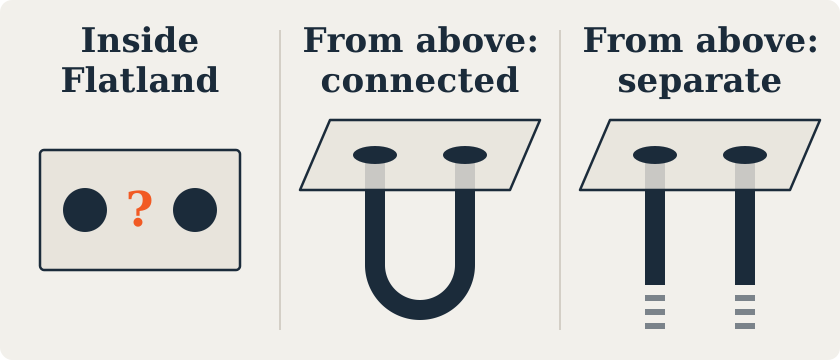
I think that is roughly where we stand with natural suffering. We see the holes. We can measure them. We can and should theorize, and I have just spent three sections doing it. But whether the holes connect, and to what, may only be visible from somewhere we do not stand. Isaiah has God say it plainly: “as the heavens are higher than the earth, so are my ways higher than your ways and my thoughts than your thoughts” (Isaiah 55:9). Paul says that for now “we see only a reflection, as in a mirror,” and know only in part (1 Corinthians 13:12). The philosopher Stephen Wykstra made the careful version of the argument in 1984: if God has reasons, we should not expect to see them from where we are, so failing to see them does not show they are not there.
That argument can go bad. “You can’t understand” can become a way to shut down every hard question, and an argument that answers everything answers nothing. I do not mean it that way. We should try to understand as much as we can. We should also know our limits. Some things may simply be out of our reach, and that is okay. It is not the end of the question. It is the edge of what I can see from here.
Even the Sphere had an edge. When A Square, newly enlightened, asks to be taken on into a fourth dimension, the Sphere answers: “There is no such land. The very idea of it is utterly inconceivable.” Earlier, when A Square was overwhelmed by his first look at Spaceland, the same Sphere had told him something kinder: “Distress not yourself if you cannot at first understand the deeper mysteries of Spaceland. By degrees they will dawn upon you.”
Every theory here is about a world with people in it, and the earth was shaking, burning, and drowning things for a very long time before there were any people to grow, choose, or build badly. That is the next part.
The candles in Lisbon were lit for the saints. Fire did what fire does.
Further Reading
Scripture quotations are from the New Revised Standard Version Updated Edition (NRSVue).
- Where Were You — the series overview
- This Is My Luck — Part 1: inconvenience, moral suffering, and free will
- “1755 Lisbon earthquake”, Wikipedia — date, time, death toll, the tsunami, and the All Saints’ Day candles
- Voltaire, “Poem on the Lisbon Disaster” (1756), in Toleration and Other Essays, trans. Joseph McCabe (1912)
- Jean-Jacques Rousseau, letter to Voltaire, August 18, 1756, in The Collected Writings of Rousseau, vol. 3, ed. Roger D. Masters and Christopher Kelly (University Press of New England, 1992), p. 110 — “nature did not construct twenty thousand houses”
- Russell R. Dynes, “The Dialogue between Voltaire and Rousseau on the Lisbon Earthquake: The Emergence of a Social Science View”, International Journal of Mass Emergencies and Disasters 18, no. 1 (2000)
- Luke 13:1–5 and John 9:1–3 — Siloam, and the man born blind
- James 2:14–26 — faith without works; “by works faith was brought to completion” (2:22, Greek eteleiōthē, from teleioō)
- 1 John 3:18 and Matthew 25:31–46 — love in deed and truth; “I was hungry and you gave me food”
- Matthew 5:43–48 — rain on the righteous and the unrighteous
- Ecclesiastes 9:11 and Proverbs 16:33 — time and chance; the lot cast into the lap
- Isaiah 55:8–9 and 1 Corinthians 13:12 — higher ways; a reflection in a mirror
- Irenaeus, Against Heresies, Book IV, chapters 37–39 — humanity made immature and meant to grow
- John Hick, Evil and the God of Love (Macmillan, 1966) — the soul-making theodicy
- C.S. Lewis, The Problem of Pain (1940), chapter 2, “Divine Omnipotence” — a fixed nature as the condition of freedom
- Richard Swinburne, Providence and the Problem of Evil (Oxford University Press, 1998)
- Fyodor Dostoevsky, The Brothers Karamazov (1880), trans. Constance Garnett, Book V, chapter 4, “Rebellion”
- Stephen J. Wykstra, “The Humean Obstacle to Evidential Arguments from Suffering: On Avoiding the Evils of ‘Appearance,’” International Journal for Philosophy of Religion 16 (1984): 73–93
- Edwin A. Abbott, Flatland: A Romance of Many Dimensions (1884)
- Stanford Encyclopedia of Philosophy, “The Problem of Evil” and “Skeptical Theism”


